 +1-3236076188
 sales@marketmonitorglobal.com

 Log In
 Log In
Home>News>Global Ultrasonic Acoustic Camera Market to Reach USD 373 Mn in 2025 and USD 531 Mn by 2032 at 5.27% CAGR
Global Ultrasonic Acoustic Camera Market to Reach USD 373 Mn in 2025 and USD 531 Mn by 2032 at 5.27% CAGR
Friday,27 Nov,2026
Market Monitor global’s report on ultrasonic acoustic cameras estimates the global market size at USD 373 million in 2025 and forecasts USD 531 million by 2032, with a 5.27% CAGR from 2026 to 2032. Ultrasonic acoustic cameras are non-contact inspection instruments that capture acoustic signals via multi-channel microphone arrays. By adopting beamforming, sound source localization, spectrum analysis and image fusion algorithms, they superimpose sound source intensity as pseudo-color acoustic maps onto visible light images. Industrial models mainly target signals above 20 kHz, while broadband versions also cover audible frequency bands for noise source localization and NVH testing. Core use cases include compressed air/gas leak detection, partial discharge diagnosis of electrical equipment, and mechanical fault inspection for bearings and conveyors. Portable handheld products dominate the market, and the product roadmap is moving toward explosion-proof certification, multi-sensor fusion, automatic quantification and cloud asset management. The industry is transforming from simple localization visualization tools into quantifiable diagnostic terminals. This analysis covers market scale, competitive tiers, frequency bands, application structure, regional layout and industrial chain value distribution.
(D(5MQUHB13}GEVMOT.webp)
2026 Competitive Landscape: Fluke, Teledyne FLIR, SONOTEC, SDT International, UE Systems Lead the First Tier; Asian Brands Accelerate Layout
The market has moderate concentration, with participants including established instrument giants, ultrasonic inspection specialists, acoustic array technology enterprises and emerging Asian manufacturers. Tier 1 players include Fluke, Teledyne FLIR, SONOTEC, SDT International and UE Systems, with advantages in industrial customer resources, ultrasonic inspection know-how, product stability, leak and partial discharge algorithms, global service network and supporting software workflows. Tier 2 vendors such as CAE Software & Systems, GFaI/gfai tech, Sorama and CS Instruments differentiate themselves through beamforming algorithms, array design and segmented acoustic testing scenarios. In Asia, HIKMICRO and KeyGo Technologies are speeding up product iteration and channel expansion. High-end professional markets focus on sensitivity, dynamic range, background noise suppression, quantification accuracy and diagnostic credibility; mid-market competition centers on ease of operation, lightweight design, price and local after-sales. Future competition will focus on AI identification, acoustic-thermal fusion, hazardous area certification, automatic maintenance priority sorting, and data interconnection with CMMS and asset management systems.
2026 Product & Demand Structure: Ultrasonic Band (>20kHz) Is the Core Growth Track; Leak Detection and Electrical Partial Discharge Are Key Scenarios
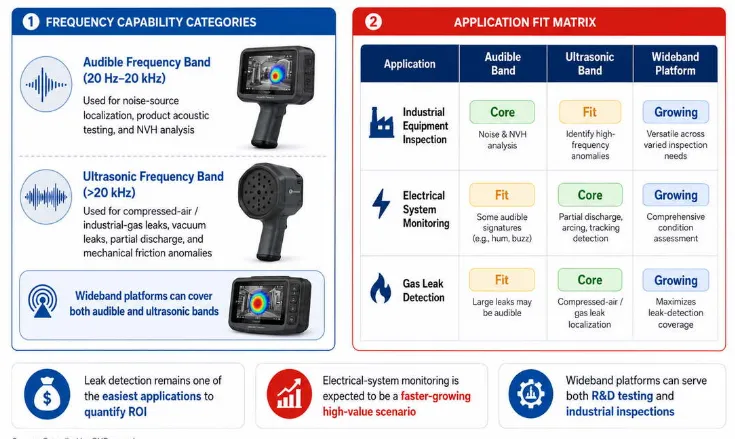
Classified by detection frequency band, the products are divided into audible band (20 Hz–20 kHz) and ultrasonic band (>20 kHz). The audible band is suitable for noise source tracing, acoustic testing and NVH analysis. Ultrasonic signals can effectively avoid low-frequency industrial background noise and are sensitive to gas turbulence, vacuum leakage, partial discharge and mechanical friction anomalies, becoming the core research direction. Some high-end broadband platforms support both frequency ranges to meet R&D testing and on-site inspection needs. Main application directions: industrial equipment inspection (bearings, valves, steam traps, conveyor systems), electrical system monitoring (partial discharge screening of switchgear, transformers, busbars and insulators), and gas leak detection (compressed air, nitrogen, vacuum and process gas pipelines). Gas leak detection is the easiest scenario to calculate ROI in the short term; electrical partial discharge monitoring will become a faster-growing high-value scenario driven by live inspection and intelligent classification upgrades.
2026 Regional Layout: North America and Europe Mature High-end Markets; Asia-Pacific Driven by Manufacturing and Local Substitution
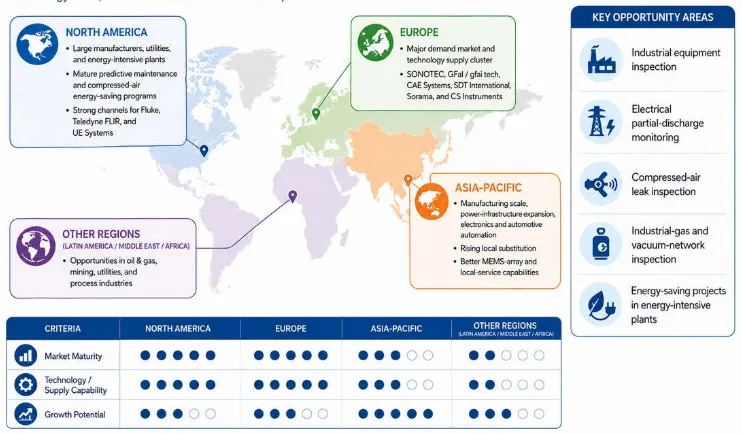
North America is supported by large manufacturing enterprises, power utilities and energy-intensive factories. Mature predictive maintenance and compressed-air energy-saving projects promote the penetration of high-end handheld acoustic cameras, and Fluke, Teledyne FLIR and UE Systems have solid channel coverage. Europe is both a major demand region and a technology supply cluster: Germany, Belgium, the Netherlands gather SONOTEC, GFaI/gfai tech, SDT International and other specialized acoustic array and inspection equipment suppliers. Asia-Pacific benefits from large manufacturing base, power infrastructure expansion, automotive and electronics automation, and domestic equipment substitution. Chinese manufacturers are rapidly improving in MEMS array, algorithm integration, cost control and local service. Other regional opportunities are concentrated in oil & gas, mining and process industries. The supply chain is shifting from monopolized by a small number of European and American specialists to multi-region competition, while advanced algorithms, calibration consistency and application experience remain key value determinants.
Industrial Chain Layout: Core Value Lies in Microphone Arrays, Algorithms, Diagnosis and Data Closed-loop Capability
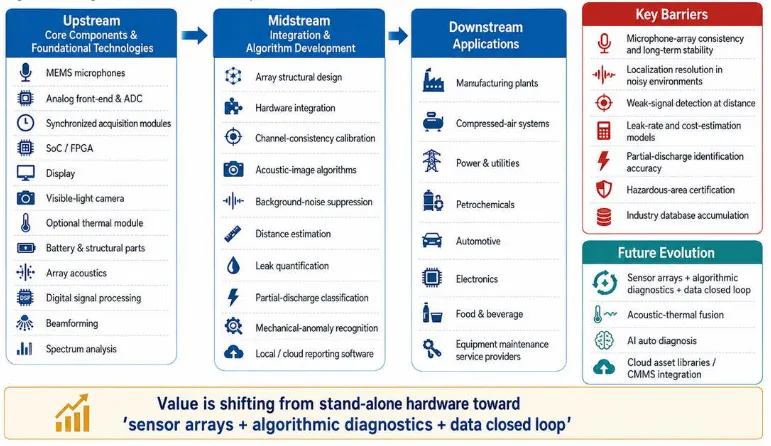
Upstream components include MEMS microphones, analog front-end and ADC chips, synchronous acquisition modules, FPGA/SoC, visible light cameras, optional thermal modules, batteries and structural parts, as well as underlying technologies such as array acoustics, beamforming and spectrum analysis. Midstream manufacturers complete array design, hardware integration, channel consistency calibration, acoustic imaging algorithms, background noise suppression, leak quantification, partial discharge classification and cloud reporting software development. Downstream customers cover discrete manufacturing, compressed air stations, power utilities, petrochemical, automotive, food & beverage and third-party maintenance service providers. Core barriers include array consistency, weak-signal detection under noisy environment, leak rate calculation models, partial discharge recognition accuracy, explosion-proof certification and fault database accumulation. The value focus is shifting from pure hardware to “sensor array + algorithm diagnosis + data closed loop”; vendors that can directly output defect severity, economic loss and maintenance priority will gain software and service premium.
LOQ5HI$[D.webp)
Risks and Commercial Opportunities
Key challenges include false alarms under complex noise, quantification errors under different gas and pressure conditions, unstable long-distance partial discharge classification, high certification costs and price competition from low-cost products. ISO 50001 energy management and IEC 60270 partial discharge standards provide favorable policy foundations. Future development directions: higher sensitivity, denser microphone arrays, AI diagnosis, multi-sensor fusion of acoustic + visible + thermal imaging, on-device real-time severity assessment, and docking with enterprise energy management and CMMS platforms. High-end market will keep being occupied by suppliers with mature algorithms, application databases and global service capability, while Asian brands will continuously capture shares in mid-range industrial inspection and localized projects.
Data source: This article is compiled with reference to the survey data and analysis in the corresponding industry report released by Market Monitor global.
Why Choose Us?

Innovative solutions
Deliver practical and innovative solutions for complex business challenges.

Comprehensive data analysis
Conduct comprehensive data analysis to dig out valuable business insights.

Rich research experience
Possess rich research experience across multiple industry verticals.

Sharp market insight
Maintain sharp market insight to capture emerging industry trends timely.
Call:
+1-3236076188 Know More About Us >>

