 +1-3236076188
 sales@marketmonitorglobal.com

 Log In
 Log In
Home>News>Global Automatic Capsule Filling Machine Market to Reach USD 210 Mn in 2026 and USD 234 Mn by 2032 at 1.8% CAGR
Global Automatic Capsule Filling Machine Market to Reach USD 210 Mn in 2026 and USD 234 Mn by 2032 at 1.8% CAGR
Thursday,26 Nov,2026
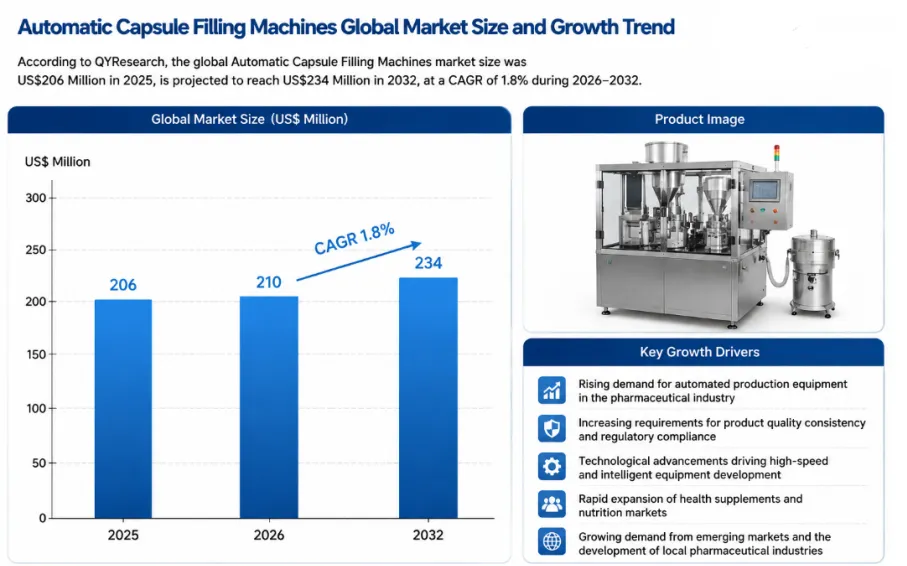
Market Monitor global’s report Global and China Automatic Capsule Filling Machine Industry Research Report (2026) estimates the global automatic capsule filling machine market at USD 206 million in 2025, USD 210 million in 2026, and forecasts USD 234 million by 2032, with a 1.8% CAGR from 2026 to 2032. An automatic capsule filling machine is core solid-dose manufacturing equipment for pharmaceuticals, dietary supplements and functional foods, performing capsule separation, quantitative filling of powder, granule, pellet or liquid materials, capsule locking and finished-product ejection. It adopts servo drive, precision metering and inline detection technologies and is split into semi-automatic and fully automatic configurations. The market is in a mature growth phase; demand originates from production line automation retrofits, equipment replacement and capacity expansion of pharma and health-product manufacturers. This analysis covers market scale, competitive tiering, product structure, regional supply and consumption layout, and industrial chain value distribution.
2026 Competitive Landscape: Syntegon, IMA Group, MG2 and ACG Worldwide Dominate the High-end Pharma Equipment Segment
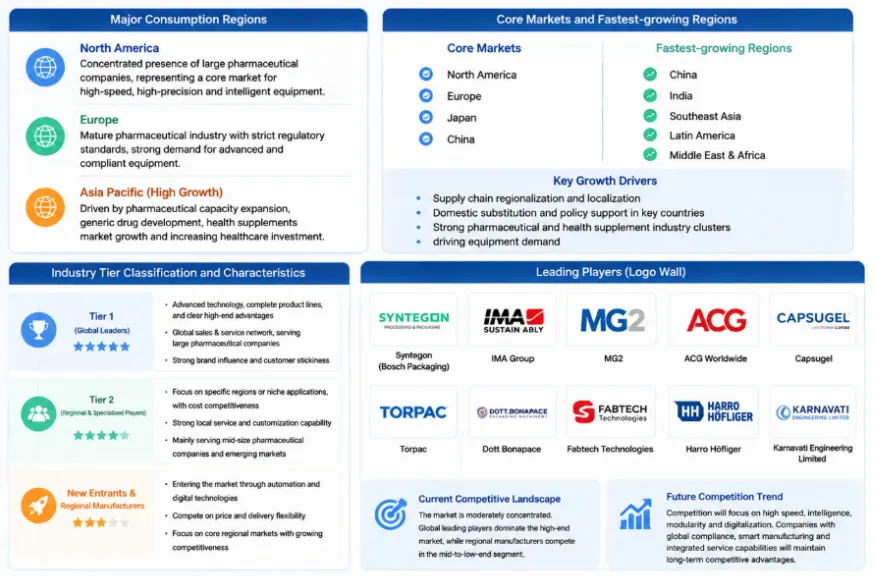
The market is highly concentrated, consisting of a small group of global first-tier pharmaceutical equipment suppliers and a large pool of regional manufacturers. Syntegon (Bosch Packaging), IMA Group, MG2, ACG Worldwide, Capsugel, Torpac, Dott Bonapace, Fabtech Technologies, Harro Höfliger and Karnavati Engineering Limited are leading global vendors. First-tier players own global service networks, validated process platforms and long-term partnerships with major pharma clients, holding advantages in high-speed filling, high-precision dosing, intelligent control and full production-line integration. Second-tier and regional suppliers target SMEs and emerging markets by leveraging lower total cost, localized after-sales, customisation and short delivery cycles. Competition is evolving from standalone mechanical performance toward modular architecture, digital traceability, GMP compliance and full-lifecycle service capability.
2026 Product Structure: Fully Automatic Capsule Fillers Capture Mainstream Large-batch Production Demand
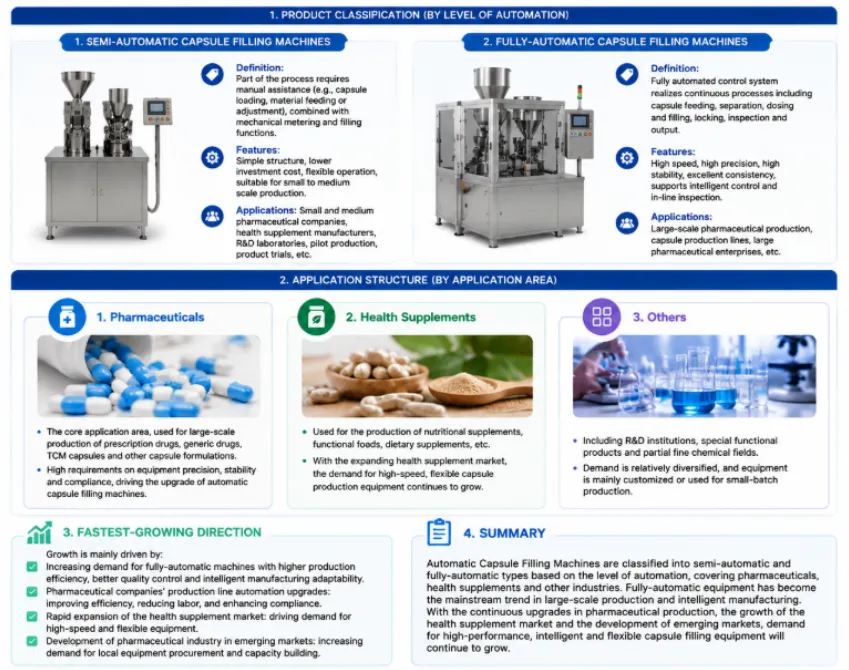
Products are classified by automation grade into semi-automatic and fully automatic models. Semi-automatic machines require manual intervention for capsule feeding or material refilling; they feature lower capital expenditure and flexible changeover, mainly deployed in laboratory R&D, pilot batches and small-batch production. Fully automatic units run continuous unmanned workflows including capsule feeding, separation, filling, closing, inspection and discharging, with superior speed, dosing consistency and batch stability, and dominate large-scale commercial capsule production lines. Pharma manufacturing is the largest application field, requiring strict regulatory compliance, while dietary supplements and functional foods form the fastest-growing downstream segment with rising demand for flexible, multi-formula filling capacity.
2026 Regional Layout: Europe Leads High-end Manufacturing; Asia-Pacific Is the Fast-growing Consumption and Production Hub
Europe retains the leading position in high-end automatic capsule filling machine supply, supported by mature pharmaceutical machinery infrastructure, precision machining capacity and strict GMP standards. North America’s demand is backed by a sophisticated biopharma and supplement industrial ecosystem and prioritises validated, traceable intelligent production equipment. Asia-Pacific, chiefly China and India, is emerging as a critical production and consumption centre. Driven by generic drug expansion, domestic equipment substitution and healthcare investment growth, local supply chains are maturing rapidly. North America and Europe remain core premium consumption markets for high-speed, high-precision machines, while Asia-Pacific demand is fuelled by capacity relocation and mid-tier equipment procurement by local health-product and pharma enterprises.
Industrial Chain Layout: Upstream Precision Components and Visual Inspection Modules Define Equipment Performance Ceiling
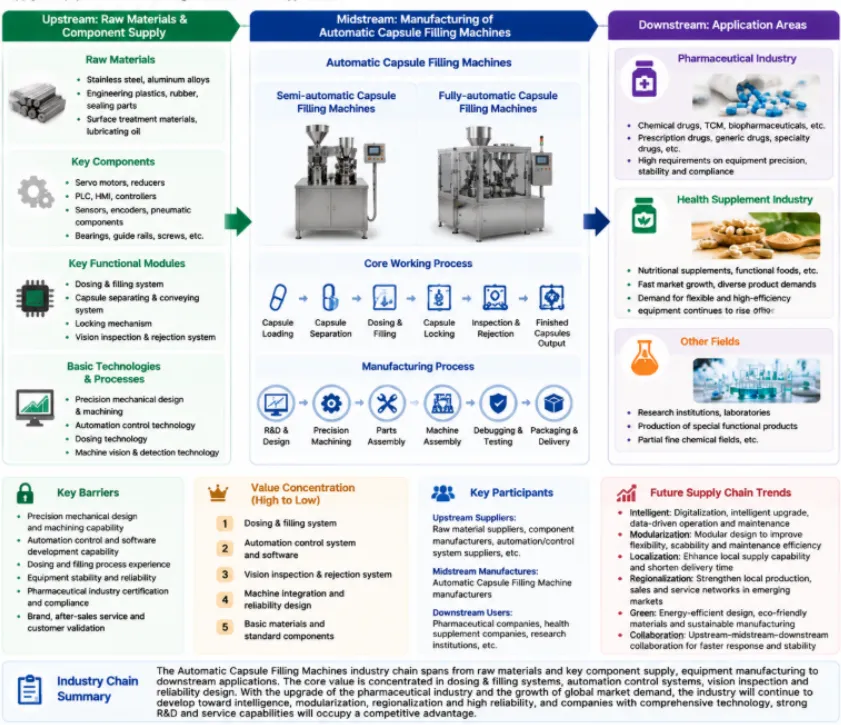
The upstream segment includes stainless steel, precision machined parts, servo motors, sensors, PLC controllers, visual inspection units and automation software. Precision machining, closed-loop dosing control and inline vision inspection form the core technical barriers. Midstream manufacturers carry out mechanical design, metering system development, automation integration, assembly and validation. Downstream buyers cover prescription drug, generic drug, traditional Chinese medicine capsule, nutritional supplement and fine chemical producers. High-end equipment value concentrates on dosing algorithms, intelligent inspection modules and line integration capability, rather than raw structural materials. The supply chain trend points to regionalised procurement and localised manufacturing in emerging markets.
Risks and Commercial Opportunities
Primary risks include long customer qualification cycles, evolving pharmaceutical regulatory standards, heavy R&D capital outlay and fragmented customised order pressure. Core opportunities lie in flexible multi-format filling platforms, inline quality inspection and batch data traceability systems suited for pharma digital transformation. Vendors capable of delivering GMP-validated modular machines and global compliance support will maintain premium positioning, while local Asian suppliers will capture incremental replacement demand from mid-market pharma and supplement factories.
Data source: This article is compiled with reference to the survey data and analysis in the report Global and China Automatic Capsule Filling Machine Industry Research Report (2026) released by Market Monitor global.
Why Choose Us?

Innovative solutions
Deliver practical and innovative solutions for complex business challenges.

Comprehensive data analysis
Conduct comprehensive data analysis to dig out valuable business insights.

Rich research experience
Possess rich research experience across multiple industry verticals.

Sharp market insight
Maintain sharp market insight to capture emerging industry trends timely.
Call:
+1-3236076188 Know More About Us >>

