 +1-3236076188
 sales@marketmonitorglobal.com

 Log In
 Log In
Home>News>All-Solid-State Battery Isostatic Pressing Equipment Market to Reach US$174.35 Million by 2032 at 14.20% CAGR, as LEAD Intelligent’s 600 MPa Horizontal WIP Achieves ±2°C and ±2% Control Precision
All-Solid-State Battery Isostatic Pressing Equipment Market to Reach US$174.35 Million by 2032 at 14.20% CAGR, as LEAD Intelligent’s 600 MPa Horizontal WIP Achieves ±2°C and ±2% Control Precision
Tuesday,24 Nov,2026
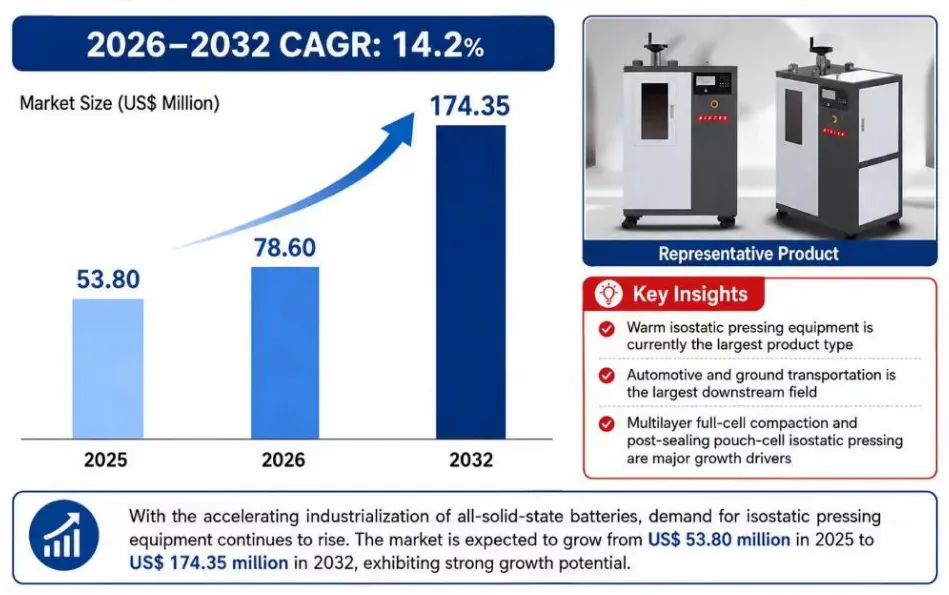
The global all-solid-state battery isostatic pressing equipment market was valued at approximately US$53.80 million in 2025, rising to approximately US$78.60 million in 2026, and is projected to reach approximately US$174.35 million by 2032, expanding at a CAGR of about 14.20% during 2026–2032, according to Market Monitor global’s report Global All-Solid-State Battery Isostatic Pressing Equipment Market 2026 by Manufacturers, Regions, Type and Application, Forecast to 2032. Typical 2025 prices ranged from US$0.15–0.60 million per laboratory system, US$0.50–2.50 million per pilot-scale system, and US$3.00–6.00 million per production-scale system, with pilot equipment representing the most characteristic revenue band. Demand is driven by the build-out of all-solid-state battery pilot and demonstration lines, multilayer-cell interfacial consolidation, and post-sealing pouch-cell processing as automakers and battery manufacturers accelerate process validation.
LEAD Intelligent’s Horizontal WIP Delivers 600 MPa and 500 L Chamber Capacity with Full Automation, While Quintus QIB 300/600 Targets Pilot-to-Production Scalability
LEAD Intelligent has introduced a horizontal warm isostatic pressing system engineered specifically for GWh-scale solid-state battery production. The equipment provides up to 600 MPa three-dimensional uniform pressure with ±2% pressure control precision and ±2°C temperature control precision across a room-temperature to 150°C range. The working cylinder features an effective inner diameter of ≥400 mm and effective length of ≥4,000 mm, yielding a chamber volume of approximately 500 L suitable for batch processing of multiple cell formats. The system integrates full automation covering preheating, cooling, automatic fixture loading and unloading, and material-frame circulation, reducing manual intervention and improving batch consistency. The horizontal architecture lowers ceiling-height requirements and enables seamless connection with automated logistics systems for continuous line operation.
Quintus Technologies, within the KOBELCO ecosystem, has launched the QIB 300 and QIB 600 series warm isostatic presses, designed to provide a production-representative platform that bridges laboratory validation and industrial manufacturing. The QIB series enables manufacturers to validate materials, large cell formats, and processes under industrially relevant conditions, with the ability to scale to larger vessels while preserving process integrity. Quintus invented the wire-wound pressure vessel and has delivered over 1,900 systems across 45 countries, with its Battery Application Centers providing material testing and process optimization support. European suppliers have positioned WIP systems for solid-state batteries at pressures up to approximately 6,000 bar (600 MPa), aligning with the industry’s mainstream pressure band.
)({CC`}V78PJ(6`F_[K.webp)
Hilok, a subsidiary of Zhuhai Chuntian Technology, has delivered a 600 MPa solid-state battery dedicated large-scale WIP system to a leading Chinese new energy enterprise in February 2026, following joint testing and validation for a GWh-level production line. The company operates a 100,000 m² manufacturing base with over 960 processing units and has cumulatively delivered more than 700 ultra-high-pressure equipment systems, with core component localization exceeding 90%.
Sichuan Lineng, partially owned by Rongqi Technology, has delivered multiple WIP systems to leading solid-state battery customers including CATL, BYD, and EVE Energy in 2024 and 2025, with all units accepted and operating satisfactorily on customer sites. The company is currently in commercial discussions for pilot-line equipment with larger chamber volumes and higher unit quantities. Its ultra-high-pressure WIP technology reaches pressures up to 1,200 MPa, providing headroom beyond current production requirements. Letone Technology rolled out its first LTWIP-600-56L experimental WIP unit on April 20, 2026, alongside the inauguration of its Ultra-High Pressure Equipment Research Institute in Zhengzhou, and offers pilot-scale LTWIP-600-169L systems positioning for the transition from R&D to mass production.
Warm Isostatic Pressing Constitutes the Mainstream Production Route, with Post-Sealing Pouch-Cell Processing Identified as the Most Common Industrial Application
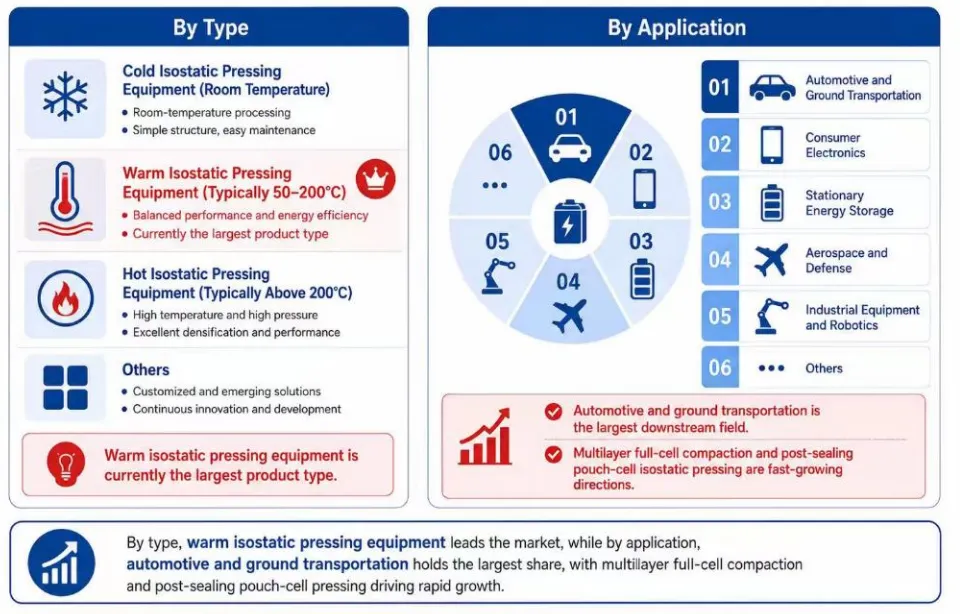
By product type, warm isostatic pressing (WIP) is the largest category and the primary pathway for scaling all-solid-state battery compaction from research to pilot and production. WIP typically combines high pressure with controlled temperatures of approximately 50–200°C, enabling densification of sulfide electrolytes and composite electrodes that uniaxial calendaring or hot pressing cannot achieve with sufficient uniformity. Common uniaxial methods lead to insufficient electrode density and lower electrochemical performance, positioning WIP as a key technology for creating sufficient particle-to-particle contact.
Cold isostatic pressing serves room-temperature densification of battery materials and solid electrolytes, while hot isostatic pressing operates above 200°C for specialized high-temperature processes with a smaller current commercial share. By application, complete multilayer-cell consolidation and post-sealing pouch-cell pressing offer the strongest industrialization potential. Commercial technology providers indicate that post-pouching and sealing is currently the most common location for WIP processing, though separate electrode and electrolyte pressing remains technically feasible. Automotive and ground transportation is the largest downstream segment, as vehicle programs require high energy density, improved safety, and scalable manufacturing. Consumer electronics and aerospace provide earlier opportunities for small-batch, high-value equipment, while stationary energy storage offers long-term volume potential contingent on cost reduction.
~E)_R`SSK.webp)
Asia-Pacific Leads Both Demand and Supplier Expansion, with China’s Domestic Equipment Pool Combining Ultra-High-Pressure Specialists and Battery-Line Integrators
Asia-Pacific is the largest demand region and the fastest-growing, reflecting the concentration of battery, automotive, and equipment value chains in China, Japan, and South Korea. China has the fastest-expanding supplier base, spanning integrated battery-line companies such as LEAD Intelligent, ultra-high-pressure machinery specialists including Sichuan Lineng and Letone, and new entrants positioning for solid-state battery processing. The domestic supply chain increasingly combines isostatic pressing with dry-electrode processing, stacking, sealing, formation, and automated logistics, with official product portfolios now including 600 MPa-class battery systems.
South Korea benefits from proximity to major battery manufacturers and a specialized equipment cluster, supporting demand for customer-near high-pressure systems and rapid engineering response. Japan combines deep capabilities in precision machinery, pressure-vessel engineering, ceramics processing, and battery materials. Europe maintains a strong position in high-end pressure-vessel engineering and scalable WIP platforms, anchored by Quintus in Sweden and other specialized suppliers in Spain and Belgium. North America has significant demand from national laboratories, battery developers, and advanced-material companies, but its publicly verified supply base for dedicated all-solid-state battery WIP equipment remains smaller than that of Europe and Asia.
Value Concentrates in Pressure-Vessel Engineering, Thermal Uniformity, and Production-Line Integration as Competition Shifts from Maximum Pressure to Repeatable Mass-Production Capability
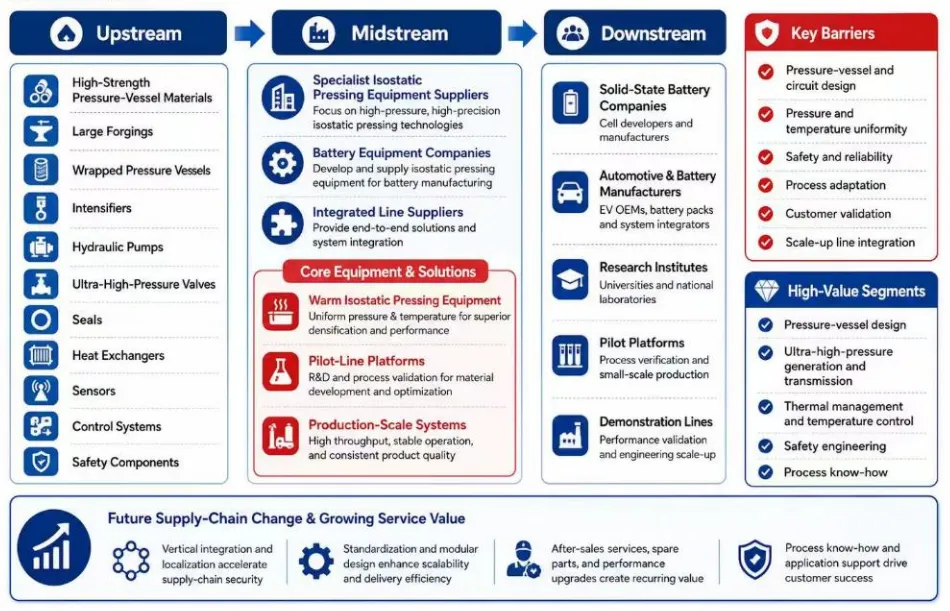
Upstream inputs include high-strength pressure-vessel materials, large forgings, wire-wound or forged cylinders, intensifiers, hydraulic pumps, ultra-high-pressure valves, seals, heat exchangers, and pressure and temperature sensors. The principal technical barriers lie in pressure-vessel and high-pressure circuit design, pressure and temperature uniformity, fatigue life, sealing reliability, and safety engineering under repeated cycles of several hundred MPa. Process barriers include rapid thermal cycling, process-window adaptation, batch loading, and production-line integration.
The highest-value activities are concentrated in pressure-vessel design, ultra-high-pressure generation and transmission, thermal management, safety engineering, and application-process know-how, while standard mechanical fabrication is less differentiated. Revenue extends beyond equipment sales into custom engineering, tooling and loading systems, installation, process introduction, spare parts, maintenance, and automation upgrades. As the installed base grows, vessel inspection, control-system upgrades, data traceability, and process-optimization services are expected to become more important.
Competition is shifting from achieving maximum pressure alone toward effective vessel volume, thermal uniformity, cycle time, automation, and verified cell-processing results. Suppliers that can demonstrate stable batch consistency, rapid cycle times, and seamless integration with upstream and downstream production equipment are positioned to capture share as the industry progresses from pilot validation toward GWh-scale manufacturing. The market remains at an early industrialization stage with a relatively limited supplier base, but the structure is becoming increasingly tiered between high-pressure technology leaders, specialized isostatic press manufacturers, and battery-equipment line integrators extending into high-pressure processing.
Data source: This article is based on survey data and analysis from the report Global All-Solid-State Battery Isostatic Pressing Equipment Market 2026 by Manufacturers, Regions, Type and Application, Forecast to 2032 published by Market Monitor global.
Why Choose Us?

Innovative solutions
Deliver practical and innovative solutions for complex business challenges.

Comprehensive data analysis
Conduct comprehensive data analysis to dig out valuable business insights.

Rich research experience
Possess rich research experience across multiple industry verticals.

Sharp market insight
Maintain sharp market insight to capture emerging industry trends timely.
Call:
+1-3236076188 Know More About Us >>

