 +1-3236076188
 sales@marketmonitorglobal.com

 Log In
 Log In
Home>News>Drone-Based Wind Turbine Blade Inspection Market Reaches US$169.00 Million in 2026, Forecast to Hit US$353.72 Million by 2032 at 13.1% CAGR
Drone-Based Wind Turbine Blade Inspection Market Reaches US$169.00 Million in 2026, Forecast to Hit US$353.72 Million by 2032 at 13.1% CAGR
Thursday,19 Nov,2026
Global Market Forecast: US$148.00 Million (2025) to US$169.00 Million (2026) to US$353.72 Million (2032), 13.1% CAGR
The global drone-based wind turbine blade inspection solution market was valued at approximately US$148.00 million in 2025, is expected to reach about US$169.00 million in 2026, and is projected to reach US$353.72 million by 2032, representing a compound annual growth rate of approximately 13.1% during 2026–2032, according to Market Monitor global's survey data and analysis in the report Global and China Drone-based Wind Turbine Blade Inspection Solution Market Status and Future Development Trends 2026-2032. The market scope covers revenue from drone inspection task execution, automated mission and flight-control software, sensing-payload configuration, data processing, AI-based defect recognition, report delivery and inspection-management platforms serving onshore and offshore wind farms.
The demand backdrop is anchored in installed-base expansion. According to IRENA's Renewable Capacity Statistics 2026, 159 GW of wind power capacity was added globally in 2025, with total wind capacity rising 14% year-on-year. This expanding asset base requires periodic blade inspection, warranty acceptance and predictive maintenance across both new-build and aging fleets. Demand is further driven by longer and more complex blades, offshore wind expansion, stricter safety requirements for work at height, and the digitalisation of wind asset management. The market is shifting from project-based aerial imaging toward repeatable, continuously operated inspection platforms, with future growth expected from offshore wind, higher-frequency inspection of ageing blades, automated drone docks and deeper integration with digital twins.
~E.webp)
Competitive Landscape: SkySpecs, Clobotics and Nearthlab Form Integrated-Solution Tier; Nearthlab Lists at US$172 Million Market Cap After 100,000 Blade Inspections Across 40 Countries
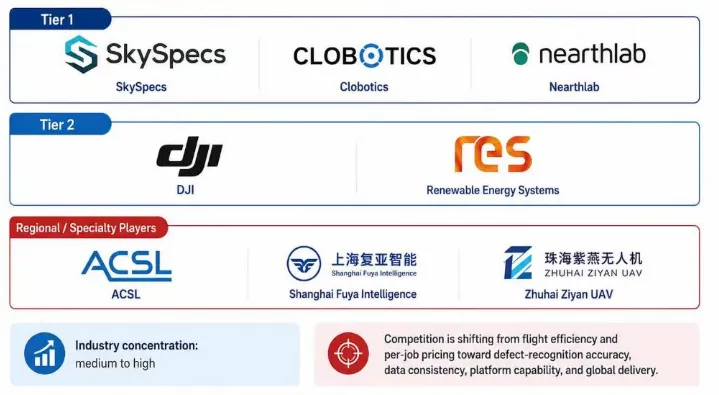
The global market includes specialised integrated-solution providers, drone-platform companies, wind O&M service groups and regional unmanned-system suppliers. SkySpecs, Clobotics and Nearthlab form the leading group in integrated autonomous inspection, standardised data capture, AI defect analytics, cloud reporting and multi-region project delivery. DJI and RES represent a second group with strengths in drone ecosystems, customer access and partner networks. ACSL, Shanghai Fuya Intelligence and Ziyan UAV participate through regional drone platforms and local project delivery.
Financial and operational data on the leading tier remain partially opaque but are becoming more visible. SkySpecs disclosed a March 2025 financing round of US$20 million at a US$400 million valuation, with investors including Statkraft Ventures, Equinor Ventures and Goldman Sachs Asset Management. Clobotics reported annual revenue of approximately US$22.9 million with 109 employees, though this figure may encompass broader inspection and maintenance services beyond pure drone inspection. Nearthlab completed its KOSDAQ listing in August 2026 at a market capitalisation of approximately US$172 million, having inspected more than 100,000 wind turbine blades across over 40 countries with a mission success rate above 99%. Its revenue mix has shifted decisively toward defense applications, with defense accounting for approximately 86% of first-half 2026 revenue of KRW 17.4 billion, illustrating the challenge of pure-play industrial inspection economics at current market scale.
The market is moderately to highly concentrated at the integrated-solution layer but remains fragmented in field execution and local service. Competition is moving beyond flight speed and per-inspection pricing toward defect-recognition accuracy, data consistency, historical defect tracking, integration with customer asset-management systems and the ability to replicate services globally.
IR]{GMZ83KD03YHEM.png)
Product Structure: Visible-Light Imaging Remains Mainstream; Fully Autonomous Flight and Multisensor Fusion Command Premium Pricing
By inspection technology, the market divides into visible-light camera payloads, infrared thermography, LiDAR and other specialised sensors. Visible-light imaging remains the mainstream route due to high resolution, mature deployment and established defect-assessment workflows for surface cracks, lightning damage, leading-edge erosion and coating abnormalities. Infrared thermography supports identification of thermal anomalies, debonding and internal damage, and is increasingly combined with visible-light imaging. LiDAR and three-dimensional modelling support blade-geometry measurement, deformation analysis and digital-twin data construction, with growing importance in large-blade and high-value asset scenarios.
By automation level, solutions are classified as manual flight, assisted autonomous flight and fully autonomous flight. Manual operations remain suitable for small fleets and complex sites; assisted-autonomous systems improve repeatability through predefined routes; fully autonomous solutions automate launch, mission execution, image capture, data return and task management. Onshore wind farms remain the largest application market, while offshore wind farms are expanding faster because of limited weather windows, high personnel-access costs and stronger demand for remote, automated and multisensor inspection. The commercial implication is that pricing power is migrating from hardware payloads toward software-defined autonomy and data continuity.
Regional Distribution: China Holds Largest Installed Base at 119.4 GW of 2025 Additions; Europe and North America Anchor Offshore and Software Value
China led global wind capacity expansion in 2025 with 119.4 GW of additions, followed by India at 6.3 GW. This installed-base concentration creates the largest addressable fleet for drone inspection, and China combines a complete drone supply chain, rapid hardware iteration and large-scale deployment capability, with particular strengths in flight platforms, payload integration, automated docks and cost efficiency. Europe benefits from a mature wind industry, extensive offshore operating experience and specialist O&M systems, supporting advantages in inspection workflows, engineering standards, data traceability and customer qualification. North American companies are strong in software platforms, wind-asset management and global service delivery, anchored by SkySpecs' US$400 million valuation and its investor base of utilities and energy majors.
Japan and South Korea contribute industrial automation, precision manufacturing and high-reliability unmanned-system technologies; Nearthlab's autonomous flight heritage in wind inspection and subsequent pivot toward defense exemplifies South Korea's dual-use technology pathway. Because aviation rules, beyond-visual-line-of-sight requirements, data compliance and site procedures differ significantly by country, regional success depends not only on technical performance but also on local pilot and service networks, customer response capability and partnerships with turbine OEMs and O&M providers. Faster growth is expected in other East Asian offshore markets, Latin America, the Middle East and Australia.
UO48CWUJQM.webp)
Upstream Industrial Chain: Drone Hardware Standardisation Shifts Value Toward AI Algorithms, Historical Data Assets and Asset-Management Integration
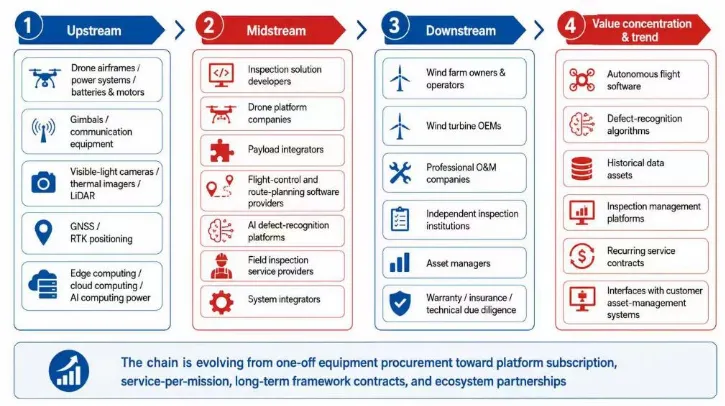
Upstream inputs include drone airframes, propulsion systems, batteries, motors, gimbals, communication equipment, high-resolution visible-light cameras, infrared imagers, LiDAR, GNSS/RTK positioning modules, edge-computing devices and cloud infrastructure. Midstream consists of inspection-solution developers, drone-platform suppliers, payload integrators, flight-control and mission-planning software companies, AI defect-recognition platforms, field-inspection service providers and system integrators. Downstream customers include wind-farm owners and operators, turbine OEMs, specialist O&M companies, independent inspection firms, asset managers and users in warranty, insurance and technical due diligence.
Key barriers include safe close-range flight around blades, high-precision positioning under variable wind conditions, mission adaptation across turbine models and blade sizes, consistent data capture, accumulated defect databases, algorithm generalisation and cross-regional project management. As drone hardware becomes more standardised, value is shifting toward autonomous-flight software, defect-recognition algorithms, historical data assets, inspection-management platforms, recurring service contracts and interfaces with customer asset systems. The supply model is therefore moving from standalone equipment procurement toward platform subscriptions, per-inspection services, long-term framework agreements and ecosystem partnerships. The adjacent wind turbine O&M market, projected at US$18.6 billion in 2025 growing at 11.7% CAGR to 2033, provides the broader context within which blade inspection spend is budgeted, though it should not be conflated with the drone inspection niche itself.
Data source: This article is compiled with reference to the survey data and analysis in the report Global and China Drone-based Wind Turbine Blade Inspection Solution Market Status and Future Development Trends 2026-2032 released by Market Monitor global.
Why Choose Us?

Innovative solutions
Deliver practical and innovative solutions for complex business challenges.

Comprehensive data analysis
Conduct comprehensive data analysis to dig out valuable business insights.

Rich research experience
Possess rich research experience across multiple industry verticals.

Sharp market insight
Maintain sharp market insight to capture emerging industry trends timely.
Call:
+1-3236076188 Know More About Us >>

