 +1-3236076188
 sales@marketmonitorglobal.com

 Log In
 Log In
Home>News>Heat Exchanger Tube Bundle Cleaning Robots: A US$146 Million Market by 2032 as Refinery Safety Rules Out Manual High-Pressure Lancing
Heat Exchanger Tube Bundle Cleaning Robots: A US$146 Million Market by 2032 as Refinery Safety Rules Out Manual High-Pressure Lancing
Wednesday,18 Nov,2026
The global heat exchanger tube bundle cleaning robot market reached US$86 million in 2025 and is projected to reach approximately US$146 million by 2032, expanding at a CAGR of roughly 7.60% during 2026–2032, according to 「 Market Monitor global 」's report Global Heat Exchanger Tube Bundle Cleaning Robots Market Report, Competitive Analysis and Regional Opportunities 2026-2032. The average 2025 ex-factory price stood at approximately US$180,000–220,000 per unit, with global unit sales of roughly 435 sets and an industry gross margin of 34%–40%. This is not a high-volume equipment category. It is a high-consequence one: each unit replaces manual lance handling in confined, high-pressure environments where a single safety failure can halt a refinery turnaround. The market's growth is therefore driven less by plant construction than by the automated replacement of existing manual and semi-manual cleaning methods, as refining and petrochemical operators tighten personnel isolation requirements and shorten shutdown windows.
{R~2V5R(KQNBMY9JGC.webp)
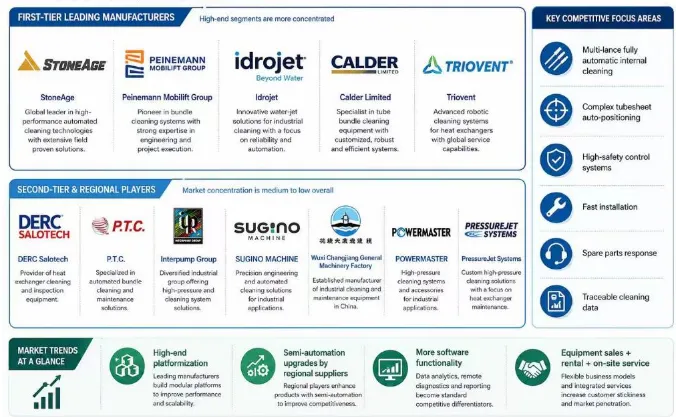
StoneAge and Interpump lead a moderately concentrated supplier field, with European and North American firms controlling advanced multi-lance systems
The supplier landscape is moderately concentrated at the top but fragmented below it. StoneAge, Inc., Interpump Group S.p.A., Idrojet S.r.l., Peinemann Mobilift Groep B.V., and Triovent GmbH form the first tier of specialized high-pressure waterjet and tube-bundle maintenance equipment providers, each with established field references in refinery and petrochemical turnarounds. European suppliers hold deeper capabilities in large multi-lance systems, external tube-bundle cleaning platforms, and fixed wash-bay installations, while North American firms lead in portable automated lance feeding, sensor-assisted positioning, and remote operation through industrial cleaning contractor channels. A second tier includes Calder Limited, DERC Salotech, P.T.C., SUGINO MACHINE, Wuxi Changjiang General Machinery, POWERMASTER, and PressureJet Systems, differentiated by high-pressure power units, customized mechanical platforms, or regional service coverage. Competition is shifting away from pressure and flow specifications alone toward tube-hole recognition accuracy, rapid setup between exchangers, multi-lance synchronization, operator isolation, and data traceability—capabilities that determine whether a contractor can complete a bundle cleaning within a tightening turnaround window rather than merely deliver water at the required pressure.
Flexible-lance systems dominate portable refinery work, while rigid multi-lance configurations serve fixed wash bays and heavy coke removal
By system form, the market divides into flexible-lance, rigid-lance, and shell-side or integrated internal/external configurations. Flexible lances are the workhorse for long tubes, constrained access, and portable multi-lance deployment, accommodating the irregular tube-sheet layouts and varied bundle geometries typical of older refineries. Rigid lances provide higher straight-line stability and push force, making them the preferred choice for heavy coke deposits, fixed wash bays, and high-volume bundle processing where throughput per shift is the primary economic metric. Shell-side and integrated systems address deposits on bundle exteriors and between tubes, a segment that is growing as operators seek to clean both tube-side and shell-side in a single setup rather than moving the bundle between stations. Typical systems operate 1–5 lances simultaneously at working pressures of 700–1,400 bar and flow rates of 50–200 L/min. By automation level, semi-automated remote-controlled systems retain broad demand because of their lower investment and adaptability to varied field conditions, while fully automated systems with vision-based tube-hole recognition, automatic indexing, and cleaning records are penetrating large refinery turnarounds and fixed wash bays more rapidly.
Refining and petrochemicals account for the largest share of demand, driven by exchanger populations and the cost of unplanned downtime
Oil refining and petrochemicals constitute the largest application segment, reflecting the sheer population of shell-and-tube exchangers in these facilities and the financial consequences of fouling-related efficiency loss. A refinery turnaround involving hundreds of exchangers creates a concentrated, time-sensitive demand spike for cleaning capacity: every day of extended shutdown carries a cost that dwarfs the price of a cleaning robot. Power generation condensers form the second major demand pool, with longer tube lengths and continuous fouling from cooling-water systems placing a premium on cleaning consistency rather than portability. Basic chemicals, steel, pulp and paper, and food processing contribute smaller but recurring volumes, typically through specialized industrial cleaning contractors rather than direct plant ownership. The rental and equipment-as-a-service model is gaining traction among small and mid-sized contractors, lowering the purchasing barrier for a US$180,000–220,000 capital item and allowing suppliers to capture recurring service revenue alongside equipment sales.
659.webp)
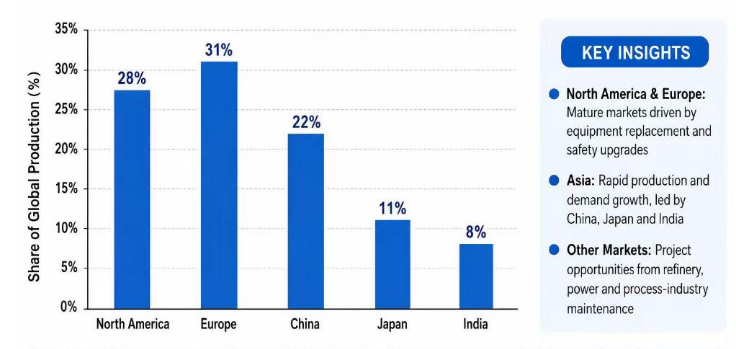
Europe and North America remain the technology and service hubs, while Asia's refining capacity expansion creates the fastest-growing demand pool
Europe anchors the high end of the supply chain, with accumulated expertise in large multi-lance systems, cabin-operated machines, certification, and engineering service. North American suppliers dominate portable automated lance feeders and sensor-assisted positioning, supported by a dense network of industrial cleaning contractors that serve refineries across the Gulf Coast and Midwest. China, Japan, and India possess established manufacturing foundations in high-pressure pumps, cleaning lances, and internal tube descaling machines, but relatively few regional companies have publicly demonstrated automatic tube-hole recognition, tube-to-tube indexing, and robotic shell-side cleaning capability. The demand geography is shifting, however. Asia and the Middle East are adding refining capacity while North America and Europe operate mature, aging asset bases that require increasingly frequent maintenance. Latin America and Africa offer project-led opportunities in refining and power generation, but service network depth—spare-parts response, commissioning support, and operator training—remains the binding constraint on adoption outside established industrial clusters.
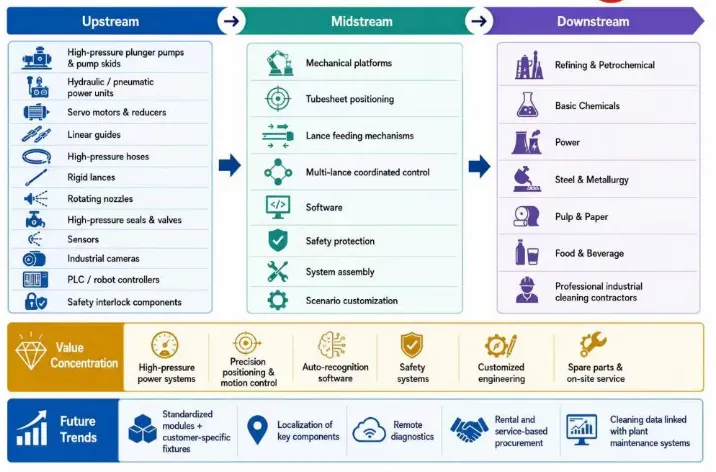
Value concentrates in positioning accuracy, functional safety, and field service rather than in pumps or lances
The upstream chain—high-pressure plunger pumps, hydraulic power units, servo motors, linear guides, high-pressure hoses, rigid lances, rotary nozzles, seals, sensors, cameras, and PLCs—is commercially mature and competitively supplied. Pump stability and seal life matter for uptime, but they are not where differentiation concentrates. Value accrues midstream in the integration of mechanical platforms, tube-sheet positioning algorithms, multi-lance control, application software, safety interlocks, and validation under contaminated, high-vibration, continuous-operation conditions. A cleaning robot that cannot reliably identify a tube hole in low-visibility conditions, or that requires extended setup between exchangers, fails the economic test regardless of its pressure rating. Downstream, value concentrates in application engineering, spare-parts response, field service, and the ability to document cleaning completion—records that refinery operators increasingly require for maintenance management and regulatory compliance. As cleaning data becomes integrated with plant maintenance-management systems, suppliers that can deliver traceable, auditable cleaning records alongside equipment will be better positioned than those selling pressure and flow alone.
Data source: This article is written based on survey data and analysis from the report Global Heat Exchanger Tube Bundle Cleaning Robots Market Report, Competitive Analysis and Regional Opportunities 2026-2032 published by 「 Market Monitor global 」.
Why Choose Us?

Innovative solutions
Deliver practical and innovative solutions for complex business challenges.

Comprehensive data analysis
Conduct comprehensive data analysis to dig out valuable business insights.

Rich research experience
Possess rich research experience across multiple industry verticals.

Sharp market insight
Maintain sharp market insight to capture emerging industry trends timely.
Call:
+1-3236076188 Know More About Us >>

