 +1-3236076188
 sales@marketmonitorglobal.com

 Log In
 Log In
Home>News>Satellite Heat Pipes: A US$298 Million Market by 2032 as Constellation Production Rewrites Thermal-Supply Economics
Satellite Heat Pipes: A US$298 Million Market by 2032 as Constellation Production Rewrites Thermal-Supply Economics
Wednesday,18 Nov,2026
The global satellite heat pipe market was approximately US$145.90 million in 2025 and is projected to reach about US$298.16 million by 2032, expanding at a CAGR of roughly 10.75% during 2026–2032, according to 「 Market Monitor global 」's report Global Satellite Heat Pipes Sales Market Report, Competitive Analysis and Regional Opportunities 2026-2032. This growth is not merely a volume story: it reflects a structural shift from bespoke, program-by-program thermal engineering toward repeatable, constellation-scale production of space-qualified two-phase thermal components. The average 2025 selling price for conventional space-grade satellite heat pipes stood at approximately US$4,500–6,000 per unit, a price band that is increasingly pressured by standardization on the low end while premium loop heat pipes and integrated assemblies command substantially higher values.
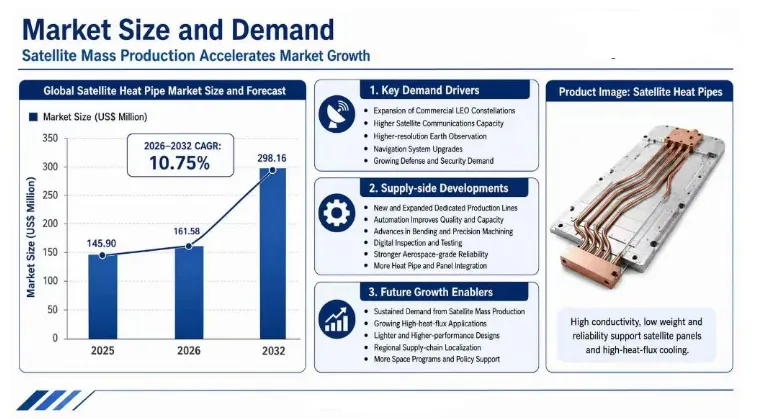
Northrop Grumman leads satellite thermal control with 11.6% of 2025 revenue; top five suppliers capture 37.6%
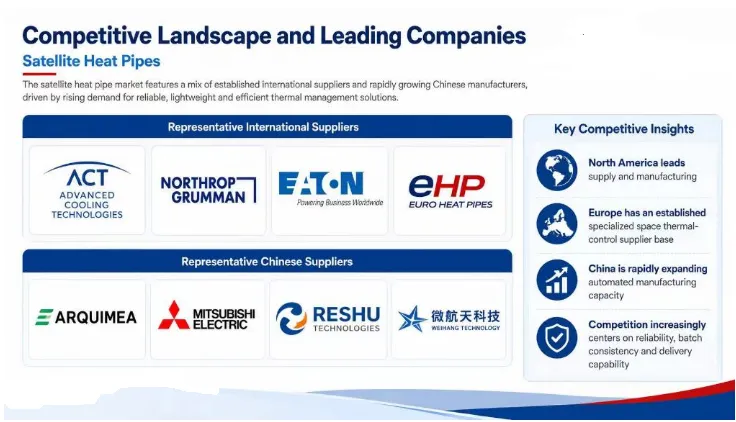
In the broader satellite thermal control systems market, Northrop Grumman holds 11.6% of 2025 revenue, followed by Thales Alenia Space at 9.7%, Airbus Defence & Space at 9.4%, Advanced Cooling Technologies at 3.7%, and Beyond Gravity at 3.2%. The five leading companies collectively account for 37.6% of the market, leaving 62.4% distributed among specialized heat-pipe manufacturers, regional engineering firms, and vertically integrated spacecraft primes. This structure matters for the heat pipe segment specifically: Northrop Grumman's thermal portfolio spans heat pipes, panels, radiators, and cryocoolers, giving it access to U.S. defense and civil space programs where flight heritage and system-level integration are prerequisites rather than differentiators. Euro Heat Pipes, majority-owned by Airbus Defence and Space, operates the only dedicated space-grade heat pipe production facility in continental Europe, with stated capacity exceeding 4,000 units annually and a new 10,000 m² facility inaugurated in 2026 that lifts capacity to 10,000 heat pipes per year. Mitsubishi Electric has delivered more than 13,500 heat pipes to global customers since 1987, anchoring Japan's high-reliability supply base. Competition is separating into two camps: high-volume standardized constellation suppliers versus high-performance customized thermal-control providers, with qualification records and production consistency mattering more than headline capacity alone.
Aluminum-ammonia axially grooved heat pipes remain the core commercial configuration, while loop heat pipes absorb premium demand
By technology type, axially grooved heat pipes—particularly aluminum-ammonia variants—constitute the most established and representative commercial route, combining low mass, mature manufacturing, and strong compatibility with satellite panel integration. These products are the workhorse of constellation production: flat-panel satellites and standardized buses favor embedded heat-pipe panels that can be produced at serial cadence rather than engineered as one-off thermal solutions. Sintered, mesh, and hybrid wick structures serve missions requiring stronger capillary performance, orientation tolerance, or localized high heat flux, while loop heat pipes and variable-conductance designs address longer transport distances, higher heat loads, and tighter temperature regulation for high-power communications, radar, and science payloads. Communications satellites remain the largest high-value application segment, with commercial small-satellite and constellation programs providing the strongest source of incremental volume. Earth observation and remote sensing contribute recurring demand as higher-resolution optical and SAR payloads increase onboard power density; defense and scientific missions offer lower volumes but sustain premium engineering and qualification requirements.
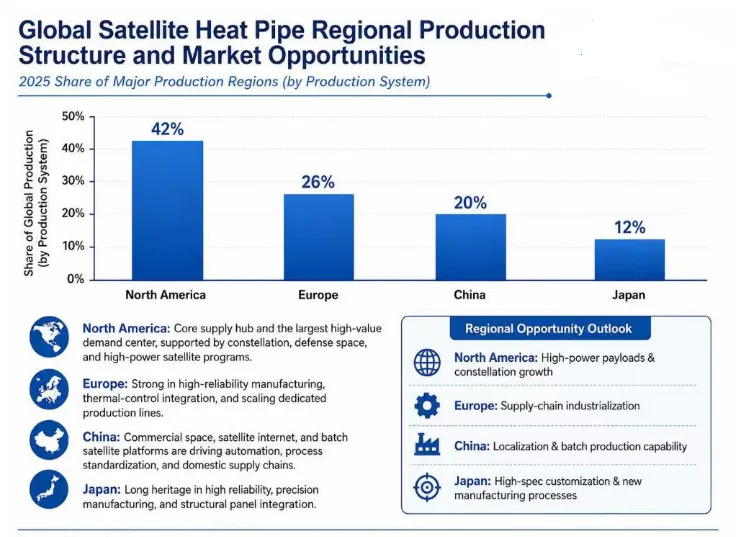
U.S. firms manufactured 83% of commercially procured satellites launched in 2025, concentrating qualified thermal-hardware demand in North America
North America remains both the leading supply base and the highest-value demand center for satellite heat pipes. The Satellite Industry Association reported that U.S. companies manufactured 83% of commercially procured satellites launched in 2025 and continued to operate more than 70% of satellites in orbit at year-end. This concentration sustains demand for flight-qualified thermal hardware across commercial constellations, defense programs, and high-power spacecraft. Europe maintains a specialized component supply base with extensive flight heritage and demonstrated megaconstellation production capability; Euro Heat Pipes' capacity expansion directly targets "new space" constellation demand. China is the fastest-moving region in terms of supply-side industrialization, with commercial space, satellite internet, and batch satellite manufacturing accelerating automation and localization of heat-pipe production. Japanese suppliers, led by Mitsubishi Electric, retain mature high-reliability manufacturing and precision panel-integration capabilities. The regional opportunity map is therefore differentiated: North America for constellation-scale qualified volume, Europe for high-heritage specialized systems and megaconstellation supply, China for localization and automated batch production, and Japan for high-specification customized thermal architectures.
Industry value concentrates in qualification, process stability, and test verification rather than raw materials
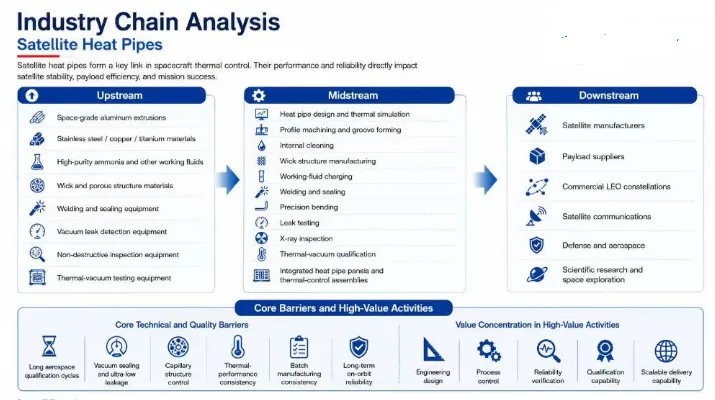
The upstream chain—aerospace-grade aluminum extrusions, copper, titanium, stainless steel, high-purity ammonia and other working fluids, and capillary materials—represents a relatively limited share of product value. Critical manufacturing infrastructure includes precision extrusion and machining, tube bending, aerospace welding, vacuum charging, helium mass-spectrometer leak detection, non-destructive inspection, and thermal-vacuum testing. Value concentration occurs midstream: thermal and capillary-limit design, groove or wick fabrication, contamination control, working-fluid purification and metered charging, hermetic sealing, non-condensable-gas control, and qualification against ECSS and equivalent standards. Qualification cycles are long, customer onboarding is slow, and batch consistency during capacity expansion is difficult to preserve—barriers that protect incumbents but also constrain how quickly new capacity can be qualified. As constellation customers push for framework supply agreements and production cadence, automated charging, batch leak testing, and standardized extrusions are reducing unit manufacturing cost for axially grooved products, while high-power payloads sustain premium pricing for loop heat pipes and integrated radiator assemblies. Suppliers combining flight heritage, automated production, and system-level thermal engineering are positioned to capture share as satellite thermal management becomes a platform-level constraint on power density, lifetime, and manufacturability.
Data source: This article is written based on survey data and analysis from the report Global Satellite Heat Pipes Sales Market Report, Competitive Analysis and Regional Opportunities 2026-2032 published by 「 Market Monitor global 」.
Why Choose Us?

Innovative solutions
Deliver practical and innovative solutions for complex business challenges.

Comprehensive data analysis
Conduct comprehensive data analysis to dig out valuable business insights.

Rich research experience
Possess rich research experience across multiple industry verticals.

Sharp market insight
Maintain sharp market insight to capture emerging industry trends timely.
Call:
+1-3236076188 Know More About Us >>

