 +1-3236076188
 sales@marketmonitorglobal.com

 Log In
 Log In
Home>News>Global 3-Phase DIN Rail Power Supplies Market to Reach $464 Million by 2032, Growing at 3.80% CAGR
Global 3-Phase DIN Rail Power Supplies Market to Reach $464 Million by 2032, Growing at 3.80% CAGR
Thursday,12 Nov,2026
3-Phase DIN Rail Power Supply: Definition and Principles
A 3-Phase DIN Rail Power Supply is an industrial AC-DC switching power supply designed to receive three-phase alternating-current input—commonly 3 × 320–600 VAC—and convert it into stable, isolated direct-current output. Typical output voltages include 12 VDC, 24 VDC, 36 VDC, 48 VDC and 72 VDC, with rated power generally ranging from 90 W to 1,000 W. The unit incorporates a mounting clip for installation on standardized 35 mm DIN rails inside electrical cabinets.
Compared with single-phase models, three-phase units distribute input current across three conductors, reducing phase current, input harmonics and component stress while supporting higher output power. Main functions include voltage regulation, galvanic isolation, power-factor correction, short-circuit and overvoltage protection, thermal protection, DC-OK signaling and temporary power boost.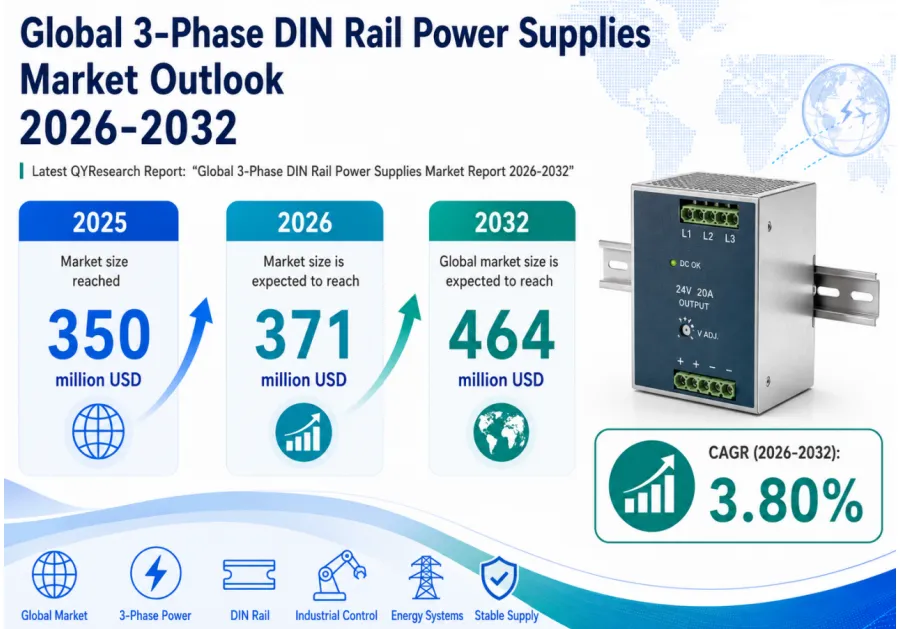
Key technical characteristics:
-
Three-phase input: Balanced current distribution across three conductors, reducing phase current and input harmonics.
-
High power density: Suitable for medium- and high-power loads in compact cabinet spaces.
-
Wide output voltage range: 12 VDC, 24 VDC, 36 VDC, 48 VDC and 72 VDC configurations.
-
Comprehensive protection: Short-circuit, overvoltage, thermal protection, and DC-OK signaling.
-
Temporary power boost: Supports peak load demands from motors, actuators, and capacitive loads.
-
Wide-temperature operation: Designed for continuous-duty industrial environments.
-
EMC performance: Compliance with industrial electromagnetic compatibility standards.
Key classification dimensions:
-
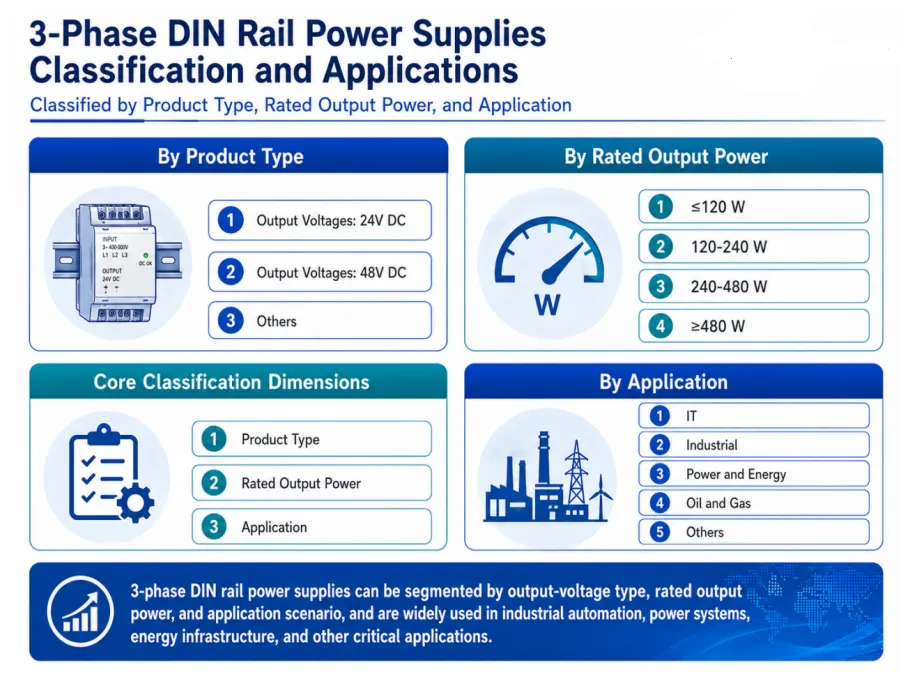
By output voltage: 24 VDC, 48 VDC, and other specifications. 24 VDC models are widely used in PLCs, sensors, relays, and industrial control circuits, while 48 VDC products are more common in communications, networking equipment, and higher-power loads.
-
By rated output power: ≤120 W, 120–240 W, 240–480 W, and ≥480 W, corresponding to different control-cabinet sizes and load requirements.
-
By application: IT infrastructure, industrial automation, power and energy, oil and gas, and other sectors.
3-Phase DIN Rail Power Supplies Market Summary
According to a new market research report published by Market Monitor Global, the global 3-Phase DIN Rail Power Supplies market is expected to maintain steady growth, supported by continued investment in industrial automation, power infrastructure, data centers, energy systems, and smart manufacturing equipment. The global market is estimated at approximately 350 million USD in 2025, increasing to 371 million USD in 2026 and reaching 464 million USD by 2032, representing a compound annual growth rate of about 3.80% from 2026 to 2032.
The market is currently experiencing steady growth, driven primarily by continued investment in industrial automation, data centers, power and energy infrastructure, oil and gas facilities, and smart manufacturing equipment. Compared with single-phase DIN rail power supplies, three-phase products are better suited for medium- and high-power loads and continuous-duty applications, offering more balanced input, higher power density, and improved system reliability. Their use is expanding in control cabinets, PLC systems, industrial robots, process control, and energy equipment.
Competition is focused on conversion efficiency, rated output power, compact design, thermal management, wide-temperature operation, EMC performance, redundancy, and safety certifications. Future growth will increasingly be supported by higher efficiency, compact design, modular architectures, digital monitoring, and improved reliability as industrial systems become more electrified and intelligent.
Competitive landscape: The global market features parallel competition among large international electrical groups, specialized industrial power-supply manufacturers, and regional suppliers.
Siemens, Schneider Electric, ABB, and Phoenix Contact maintain strong positions in major industrial projects and high-reliability applications through established brands, automation platforms, global channels, and system-integration capabilities.
PULS, Mean Well, TDK-Lambda, Delta Electronics, and Omron compete through specialized product portfolios, high-efficiency designs, broad power coverage, and cost optimization.
Key competitive factors include conversion efficiency, reliability, compactness, power density, wide-temperature operation, redundancy, EMC performance, and global certifications. Going forward, digital monitoring, modular expansion, remote diagnostics, and localized delivery capabilities will become increasingly important in determining competitive positioning.
JXL}UQ0H)USI9A.webp)
Industry Chain Analysis
The 3-Phase DIN Rail Power Supplies industry chain consists of upstream electronic components and structural materials, midstream power-supply design and manufacturing, and downstream industrial applications.
Upstream inputs include power semiconductors, rectifiers, transformers, magnetic components, capacitors, resistors, protection devices, control ICs, PCBs, connectors, terminals, metal housings, and DIN rail structural parts. Their performance directly affects conversion efficiency, temperature rise, EMC performance, and service life.
Midstream manufacturers focus on three-phase input topology, power conversion, thermal management, EMC design, protection circuits, and certification compliance, followed by SMT assembly, potting, aging, and testing.
Downstream demand comes mainly from IT infrastructure, industrial automation, power and energy, and oil and gas. Industry value is increasingly concentrated in high-efficiency power devices, magnetic components, control ICs, and system-integration capabilities.
Regional Landscape and Market Opportunities
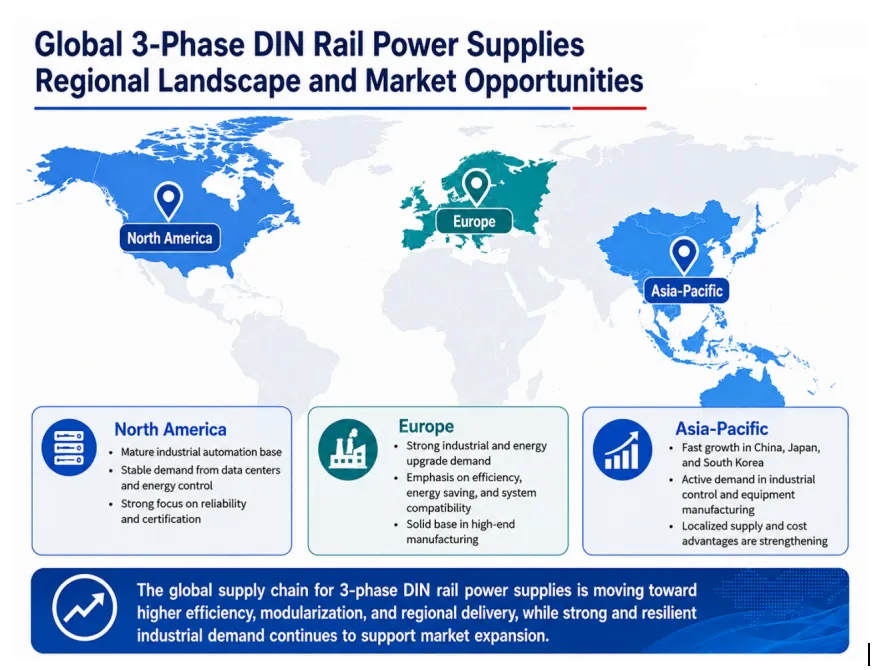
The global 3-Phase DIN Rail Power Supplies market is concentrated in North America, Europe, and Asia-Pacific.
North America has a mature industrial automation base, with stable investment in data centers, energy control, and critical infrastructure, supporting strong demand for highly reliable, certified, continuous-duty power supplies.
Europe benefits from advanced industrial equipment and automation sectors and places particular emphasis on energy efficiency, safety standards, EMC, and system compatibility, sustaining demand for premium DIN rail power products.
Asia-Pacific, especially China, Japan, and South Korea, is experiencing continued expansion in manufacturing automation, equipment upgrades, power infrastructure, and data-center construction. Localized manufacturing and cost advantages are also strengthening.
Across regions, the market is moving toward higher efficiency, modularity, digitalization, and regional supply, while industrial control and energy-system upgrades continue to generate new opportunities.
Market Segment Analysis
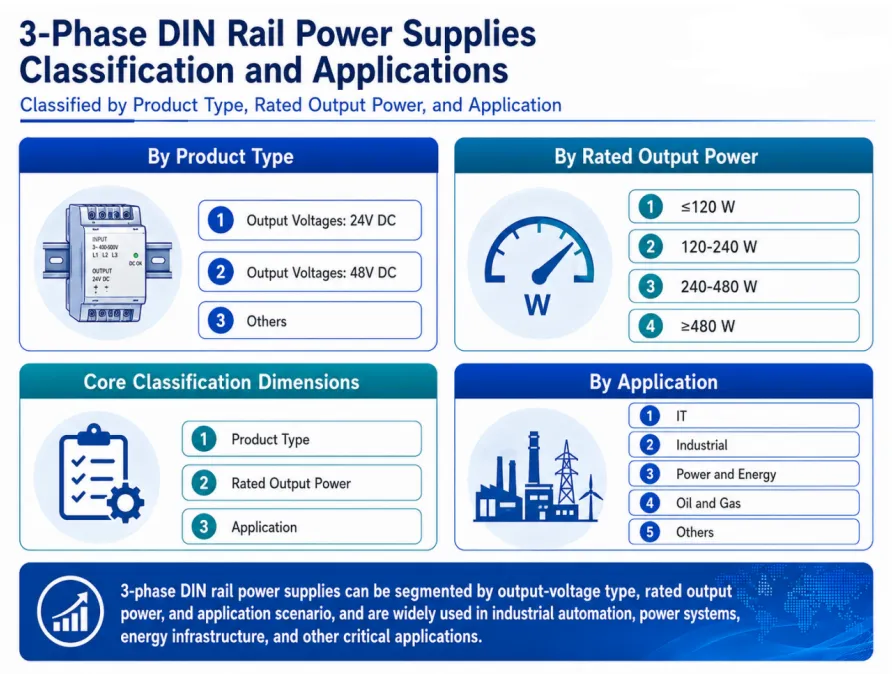
By output voltage, major categories include 24V DC, 48V DC, and other specifications. 24V DC models are widely used in PLCs, sensors, relays, and industrial control circuits, while 48V DC products are more common in communications, networking equipment, and higher-power loads.
By rated output power, products can be divided into ≤120 W, 120–240 W, 240–480 W, and ≥480 W, corresponding to different control-cabinet sizes and load requirements.
By application, the market includes IT, industrial, power and energy, oil and gas, and other sectors. As equipment integration increases, users are placing greater emphasis on power density, compact installation, wide input capability, redundancy, low temperature rise, and long-term reliability.
Key Market Drivers
The first driver is continued investment in industrial automation and smart manufacturing. Three-phase DIN rail power supplies are essential for control cabinets, PLC systems, industrial robots, process control, and energy equipment, supporting the ongoing electrification and digitalization of industrial systems.
The second driver is the expansion of data centers and IT infrastructure. The growing demand for reliable, high-efficiency power supplies in data centers and networking equipment is driving demand for 48 VDC and higher-power three-phase DIN rail products.
The third driver is power and energy infrastructure investment. Power generation, transmission, and distribution equipment require highly reliable, certified power supplies for control and monitoring systems.
The fourth driver is the need for higher efficiency, compact design, modular architectures, digital monitoring, and improved reliability as industrial systems become more electrified and intelligent.
Key Market Restraints
The first restraint is the relatively high cost of three-phase power supplies compared to single-phase alternatives. Three-phase products require more complex input topology, higher-rated components, and more sophisticated thermal management, increasing unit cost.
The second restraint is the complexity of installation and integration. Three-phase input requires proper wiring, phase balancing, and compliance with local electrical codes, adding installation complexity compared with single-phase solutions.
The third restraint is competition from alternative power supply architectures. Single-phase DIN rail power supplies, modular power supplies, and integrated power solutions compete in certain applications, limiting market growth in price-sensitive or lower-power segments.
Industry Trends
-
24V DC as the dominant output voltage: Widely used in PLCs, sensors, relays, and industrial control circuits.
-
Higher efficiency and compact design: Driven by the need to reduce energy consumption and save cabinet space.
-
Modular architectures and digital monitoring: Increasingly important for system integration and predictive maintenance.
-
Wide-temperature operation and EMC performance: Critical for continuous-duty industrial environments.
-
Regional supply and localized manufacturing: Strengthening in Asia-Pacific to serve local demand and reduce lead times.
-
Growing demand from data centers and energy infrastructure: Supporting steady market growth.
-
Consolidation among specialized suppliers: Large electrical groups and specialized power-supply manufacturers competing on technology, certifications, and cost.
Key Success Factors
-
Conversion efficiency and reliability: High efficiency, low temperature rise, and long service life.
-
Power density and compactness: Smaller footprint for space-constrained control cabinets.
-
Wide-temperature and EMC performance: Compliance with industrial standards and reliable operation in harsh environments.
-
Global certifications: Meeting safety, EMC, and regional market-access requirements.
-
System integration capability: Compatibility with automation platforms and control systems.
-
Digital monitoring and remote diagnostics: Enabling predictive maintenance and smart manufacturing integration.
-
Cost competitiveness and localized delivery: Efficient manufacturing and regional supply capabilities.
Why Choose Us?

Innovative solutions
Deliver practical and innovative solutions for complex business challenges.

Comprehensive data analysis
Conduct comprehensive data analysis to dig out valuable business insights.

Rich research experience
Possess rich research experience across multiple industry verticals.

Sharp market insight
Maintain sharp market insight to capture emerging industry trends timely.
Call:
+1-3236076188 Know More About Us >>

