 +1-3236076188
 sales@marketmonitorglobal.com
 Log In
  Log In
 Home>News>Global Point-to-Multipoint Microwave Backhaul System Market to Reach $0.35 Billion by 2031, Growing at 8.8% CAGR
Global Point-to-Multipoint Microwave Backhaul System Market to Reach $0.35 Billion by 2031, Growing at 8.8% CAGR
Tuesday,11 Aug,2026
Point-to-Multipoint Microwave Backhaul System: Definition and Principles
The Point-to-Multipoint Microwave Backhaul System is a wireless communication technology enabling a central site to simultaneously transmit data to multiple remote sites via microwave links. By establishing microwave connections between the central and terminal nodes, this system delivers high-bandwidth data transmission and network backhaul capabilities. It is widely deployed in mobile communication networks, broadcast television, and internet service provider infrastructures, particularly in regions where wired infrastructure development is challenging. Key advantages include deployment flexibility, cost-effectiveness, and high transmission throughput.
Key technical characteristics:
-
Hub-and-spoke architecture: A central hub communicates with multiple remote nodes, enabling efficient data distribution and aggregation.
-
High-bandwidth transmission: Supports high-capacity data backhaul for mobile networks and broadband access.
-
Deployment flexibility: Rapid deployment in areas where fiber or wired infrastructure is challenging.
-
Cost-effectiveness: Lower infrastructure costs compared to fiber deployment, particularly in rural and remote areas.
-
Spectrum efficiency: Advanced modulation and adaptive coding optimize spectrum utilization.
Key application scenarios:
-
Mobile backhaul: Connecting cell towers and small cells to core networks.
-
Fixed wireless access: Broadband connectivity for residential and enterprise customers.
-
Private networks: Industrial, energy, and transportation networks requiring low-latency and reliable transmission.
-
Emergency communications: Rapidly deployable networks for disaster recovery and crisis response.
-
Broadcast television: Distribution of television signals to remote transmission sites.
Point-to-Multipoint Microwave Backhaul System Market Summary
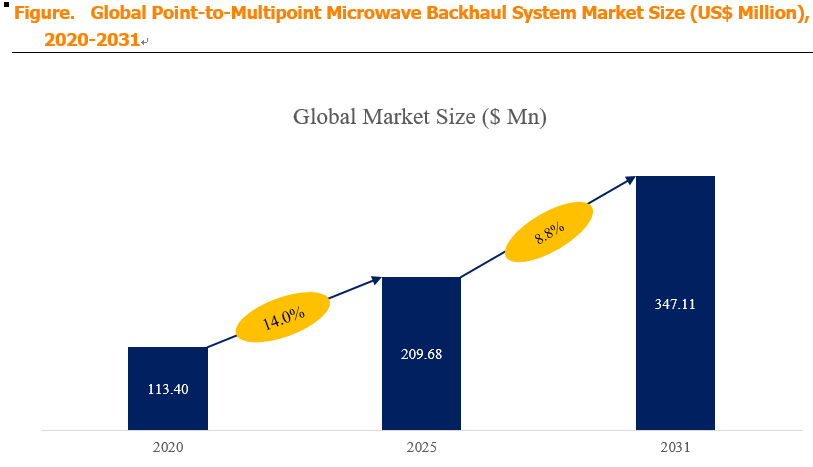
According to a new market research report published by Market Monitor Global, the global Point-to-Multipoint Microwave Backhaul System market is projected to reach approximately 0.35 billion USD by 2031, growing at a compound annual growth rate of 8.8% during the forecast period. This growth is driven by global 5G network densification requiring cost-effective backhaul solutions, industrial internet development driving private network investments, and increasing demand for resilient emergency communication networks.
Market Monitor Global's analysis indicates that the global key manufacturers of Point-to-Multipoint Microwave Backhaul Systems include Ubiquiti Inc. , Cambium Networks, Ceragon Networks, Intracom Telecom, and Cambridge Broadband Networks. In 2024, the global top five players collectively accounted for approximately 55.0% of total revenue, indicating a moderately concentrated market with established players and a mix of specialized microwave technology companies.
Ubiquiti Inc. is a US-based technology company specializing in wireless networking and telecommunications equipment, offering point-to-multipoint microwave backhaul solutions for service providers and enterprise customers.
Cambium Networks is a US-based wireless networking company providing point-to-multipoint microwave and millimeter-wave backhaul solutions for mobile and fixed network operators.
Ceragon Networks is a global leader in wireless backhaul solutions, offering point-to-multipoint microwave systems for 5G and mobile network applications.
Intracom Telecom is a Greek telecommunications equipment provider offering point-to-multipoint microwave backhaul systems for mobile and fixed network operators.
Cambridge Broadband Networks is a UK-based company specializing in point-to-multipoint microwave solutions for mobile backhaul and enterprise applications.
In terms of product type, the market is segmented by frequency band — Sub-6GHz and Millimeter-Wave. Millimeter-wave products are the fastest-growing segment, driven by 5G deployment and the increasing demand for high-capacity backhaul in dense urban areas.
Regarding application, Mobile Backhaul is the largest application segment, driven by the need to connect cell towers and small cells to core networks. Fixed Wireless Access is a growing segment, driven by demand for broadband connectivity in underserved areas. Private Networks and Emergency Communications account for the remainder.
Regional dynamics: North America is a significant market driven by 5G deployment and private network investments. Europe is a mature market with strong focus on millimeter-wave and high-frequency solutions. The Asia-Pacific region is the fastest-growing market, led by China, India, and Southeast Asia, where 5G deployment and fixed wireless access expansion are accelerating. Latin America and the Middle East & Africa are emerging markets with growth potential driven by infrastructure expansion and connectivity needs.
Point-to-Multipoint Microwave Backhaul System Market Dynamics
Market Drivers:
The first driver is global 5G network densification. 5G networks require dense deployment of small cells and base stations, creating demand for cost-effective backhaul solutions. Point-to-multipoint microwave systems provide a flexible and rapidly deployable alternative to fiber in many scenarios.
The second driver is industrial internet and private network investments. Energy, transportation, and industrial sectors are investing in private networks requiring low-latency, reliable transmission. Point-to-multipoint microwave systems are well-suited for these applications due to their deployment flexibility and cost-effectiveness.
The third driver is the increasing frequency of natural disasters and the need for resilient emergency networks. Point-to-multipoint microwave systems can be rapidly deployed in disaster-affected areas to restore communication services.
The fourth driver is the expansion of fixed wireless access networks. Service providers are increasingly using fixed wireless access to deliver broadband connectivity to underserved areas. Point-to-multipoint microwave systems provide a cost-effective solution for connecting multiple remote terminals to a central hub.
Market Restraints:
One major restraint is spectrum availability and regulatory constraints. Microwave spectrum is limited and subject to regulatory allocations and licensing requirements. Interference management and spectrum sharing can be challenging in dense urban environments.
Another restraint is competition from fiber optic technology. As fiber deployment costs decline and coverage expands, fiber is becoming a competitive alternative to microwave backhaul in many areas.
Environmental factors such as rain fade, atmospheric absorption, and line-of-sight requirements can affect system performance and reliability, particularly at millimeter-wave frequencies.
Market Opportunities:
A significant opportunity lies in the expansion of millimeter-wave backhaul solutions. The growing demand for high-capacity backhaul in 5G networks is driving adoption of millimeter-wave point-to-multipoint systems. Advances in RF technology and beamforming are improving system performance and reliability.
Another opportunity is the development of hybrid fronthaul/backhaul solutions for 5G networks. As network architectures evolve, there is growing demand for integrated solutions that combine fronthaul and backhaul capabilities.
The expansion of point-to-multipoint microwave in private networks and enterprise applications presents growth opportunities. Energy, transportation, and industrial sectors are deploying private networks requiring specialized backhaul solutions.
Finally, the integration of artificial intelligence and machine learning for network optimization presents opportunities. AI-driven solutions can automate spectrum allocation, interference mitigation, and predictive maintenance, improving network efficiency and reducing operational costs.
345N_DQOX34.png)
Industry Trends:
-
5G network densification: Driving demand for cost-effective backhaul solutions.
-
Millimeter-wave adoption: Increasing use of high-frequency bands for high-capacity backhaul.
-
Private network growth: Industrial and enterprise investments driving demand for specialized backhaul solutions.
-
Fixed wireless access expansion: Growing demand for broadband connectivity in underserved areas.
-
Emergency communication networks: Rapidly deployable solutions for disaster recovery.
-
AI-driven network optimization: Integration of AI for spectrum management and predictive maintenance.
-
Moderately concentrated market: Top five players account for ~55% of revenue with established players dominating.


