 +1-3236076188
 sales@marketmonitorglobal.com
 Log In
  Log In
 Home>News>Global Two-Platen Injection Molding Machine Market to Reach $2.77 Billion by 2032, Growing at 4.08% CAGR
Global Two-Platen Injection Molding Machine Market to Reach $2.77 Billion by 2032, Growing at 4.08% CAGR
Tuesday,11 Aug,2026
Two-Platen Injection Molding Machine: Product Introduction
A two-platen injection molding machine is an injection molding equipment whose clamping mechanism mainly consists of two core plates: a fixed platen and a moving platen. Compared to traditional three-platen injection molding machines, it eliminates the rear platen and long elbow mechanism. It typically uses hydraulic or servo hydraulic methods to complete mold opening and high-pressure clamping. It features a compact structure, small footprint, large mold space, long mold opening stroke, and suitability for large molds. Two-platen injection molding machines are mainly used for molding medium and large-sized plastic products, specifically including automotive bumpers, dashboards, appliance housings and internal structural parts, logistics pallets, large turnover boxes, sanitation garbage bins, and large industrial containers.${I$YUUD2ZL~NE9YJR}B.png)
Key technical characteristics:
-
Two-platen clamping system: Simplified design with fixed and moving platens, eliminating the rear platen and toggle mechanism.
-
Compact footprint: Shorter machine body compared to traditional three-platen machines, saving factory floor space.
-
Ample mold space: Large mold mounting area and long mold-opening stroke for accommodating large molds and deep-draw parts.
-
High clamping force: Suitable for large, heavy molds and high-tonnage applications.
-
Servo-hydraulic and hybrid drives: Energy-efficient and precise drive systems for improved performance and reduced energy consumption.
-
Large mold load-bearing capacity: Ability to handle heavy molds for large parts.
Key applications:
-
Automotive: Bumpers, front-end modules, tailgates, underbody shields, battery-related plastic components, large interior/exterior trim.
-
Home Appliances: Washing machine tubs, air conditioner housings, refrigerator components, large appliance structural parts.
-
Logistics and Packaging: Pallets, large turnover boxes, waste bins, storage containers, industrial vessels.
-
Industrial Products: Large structural components, industrial containers, pipe fittings.
Two-Platen Injection Molding Machine Market Summary
According to a new market research report published by Market Monitor Global, the global Two-Platen Injection Molding Machine market is projected to reach approximately 2.77 billion USD by 2032, growing at a compound annual growth rate of 4.08% during the forecast period. This growth is driven by increasing demand from the automotive and new energy vehicle sectors, the upscaling of logistics packaging and home appliances, customer demand for energy efficiency and reduced unit manufacturing costs, and the expansion of emerging manufacturing markets.
Market Monitor Global's analysis indicates that the global key manufacturers of Two-Platen Injection Molding Machines include Haitian Plastics Machinery Group, ENGEL, KraussMaffei Group, Yizumi, and Milacron. In 2025, the global top five players collectively accounted for approximately 46.85% of total revenue, while the global top ten players held approximately 61.60%, indicating a moderately concentrated market with a mix of leading global and Chinese manufacturers.
Haitian Plastics Machinery Group is the world's largest manufacturer of injection molding machines, headquartered in China. The company offers a comprehensive range of injection molding solutions, including large two-platen machines for automotive, logistics, and home appliance applications. Haitian's Mars series and Jupiter series are widely recognized for their reliability and performance.
ENGEL is an Austrian-based global leader in injection molding machine manufacturing, offering a wide range of solutions from small precision machines to large two-platen systems. ENGEL's large two-platen machines are known for their high precision, energy efficiency, and advanced automation integration, serving premium automotive and technical molding applications.
KraussMaffei Group is a German-based manufacturer of injection molding machines, extrusion systems, and reaction molding equipment. The company offers large two-platen machines with advanced clamping systems and process control technologies, serving automotive, packaging, and industrial applications.
Yizumi is a Chinese manufacturer of injection molding machines and die-casting equipment, offering large two-platen machines for automotive, home appliance, and logistics applications.
Milacron is a US-based global manufacturer of injection molding machines and extrusion equipment, serving the automotive, packaging, and industrial markets.
In terms of clamping force, machines with clamping forces between 450 tons and 1,000 tons represent the largest segment, driven by demand from automotive interior and exterior components and logistics packaging. Machines above 1,000 tons are the fastest-growing segment, driven by demand for large automotive parts, pallets, and industrial containers.
Regarding application, Automotive is the largest application segment, driven by the production of bumpers, front-end modules, tailgates, and large interior/exterior trim. Logistics and Packaging is the second-largest segment, driven by demand for pallets, turnover boxes, and storage containers. Home Appliances is a significant segment, with demand for large appliance housings and components.
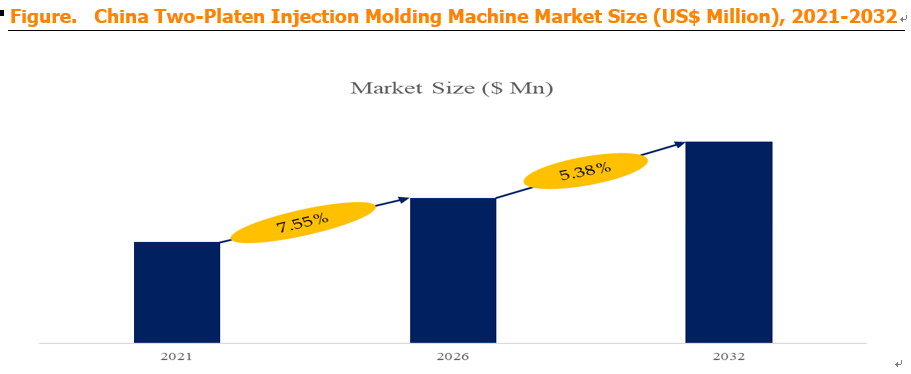
Regional dynamics: Asia-Pacific is the largest and fastest-growing market, led by China's dominant position in injection molding machine manufacturing and its massive automotive, home appliance, and logistics industries. North America and Europe are mature markets, driven by automotive production, replacement demand, and upgrades to energy-efficient and hybrid drive systems. Emerging markets in Southeast Asia, India, Mexico, and Turkey are absorbing production capacity for automotive, packaging, and industrial plastic components, generating new demand for medium-to-large-scale injection molding equipment.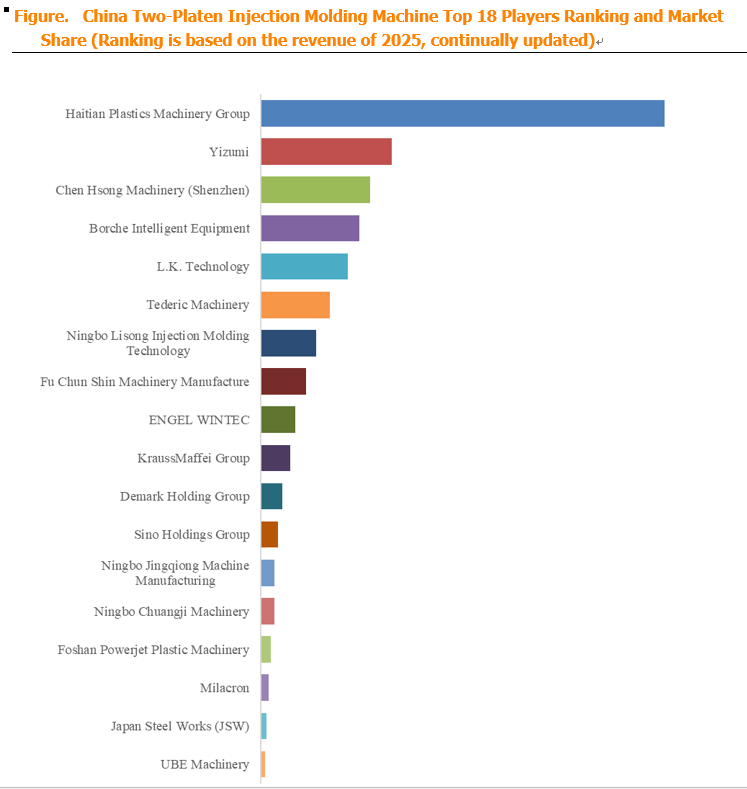
Main Development Trends
Increasing Demand for High Tonnage and Large, Complex Parts: Leveraging advantages such as high clamping force, ample mold space, long mold opening strokes, and a compact footprint, two-platen injection molding machines are seeing expanded application in the production of large-scale plastic products — including automotive exterior components, large home appliances, logistics pallets, turnover boxes, and industrial containers.
New Energy Vehicles and Automotive Lightweighting as Core Growth Drivers: Investment within the global automotive supply chain, coupled with expanded production of new energy vehicles and the growing demand for lightweight components, is fueling the growth in demand for two-platen injection molding machines. Battery-related plastic components, underbody shields, and large interior/exterior trim parts are key application areas.
Equipment Upgrades Focus on Energy Efficiency, Servo-Hydraulics, and Hybrid Drives: Two-platen injection molding machines are evolving from traditional large-scale hydraulic systems toward servo-hydraulic, hybrid-drive, and partially electric configurations, aiming to reduce energy consumption while enhancing operational precision and stability. Energy efficiency is becoming a key purchasing criterion for large-scale manufacturers.
Integration of Intelligence, Automation, and Digitalization: Global customers are shifting their focus beyond the mere purchase of standalone machines; instead, they are increasingly prioritizing comprehensive solutions that incorporate robotic manipulators, mold temperature controllers, material feeding systems, mold monitoring, energy consumption tracking, data traceability, and MES interfaces. The integration of automation cells, robotics, and digital systems is becoming a key competitive focus.
Expansion of Emerging Manufacturing Markets: Manufacturing hubs in regions such as China, India, Southeast Asia, Mexico, and Turkey continue to absorb production capacity for automotive, packaging, home appliance, and industrial plastic components, thereby generating new demand for medium-to-large-scale injection molding equipment.
Market Opportunities
Automotive and NEV Sector Growth: The most significant opportunity lies in the growing demand from the automotive and new energy vehicle sectors. Products such as bumpers, front-end modules, tailgates, underbody shields, battery-related plastic components, and large interior/exterior trim parts require high clamping forces and ample mold space; these sectors represent the primary growth drivers for two-platen injection molding machines. As the NEV sector expands globally, demand for lightweight, large-format plastic components is increasing.
Logistics Packaging and Industrial Containers: Global demand for pallets, turnover boxes, waste bins, storage containers, and large industrial vessels is experiencing steady growth. Given the large mold volumes and product dimensions associated with these items, the two-platen machine structure is ideally suited for the production of these items. The continued expansion of e-commerce and global supply chains is driving demand for logistics packaging.
Energy Efficiency and Cost Reduction: In the production of large-scale parts, two-platen machines offer significant advantages by saving factory floor space, lowering energy consumption, minimizing downtime, and enhancing production efficiency for large molds. Customer demand for energy efficiency and reduced unit manufacturing costs is driving equipment upgrades.
Automation and Lean Manufacturing: Customers across the automotive, packaging, home appliance, and industrial goods sectors are placing greater emphasis on stable mass production, automated part extraction, real-time monitoring, and data traceability. This trend is driving the integrated sales of two-platen machines bundled with automation cells, robotics, and digital management systems.
Emerging Manufacturing Markets: Manufacturing hubs in regions such as China, India, Southeast Asia, Mexico, and Turkey continue to absorb production capacity for automotive, packaging, home appliance, and industrial plastic components, thereby generating new demand for medium-to-large-scale injection molding equipment.0CTJI(V})D_7YF.webp)
Challenges and Obstacles
High Unit Costs and Sensitivity to Downstream Capital Expenditure: Two-platen injection molding machines command a high unit price, and the associated investment cycle is significantly influenced by capital expenditure in downstream sectors. Consequently, any slowdown in investment within the automotive, packaging, and home appliance industries — the primary downstream markets — leads to noticeable fluctuations in order volumes.
High Barriers to Entry in Large-Machine Manufacturing: The production of two-platen injection molding machines entails the machining of large castings, ensuring the precision of clamping mechanisms, maintaining platen parallelism, and integrating sophisticated hydraulic and control systems — in addition to on-site installation and commissioning. This places rigorous demands on a manufacturer's machining capabilities, assembly expertise, and after-sales service network.
Technical Barriers in High-End Process Applications: Applications involving automotive exterior components, multi-component molding, long-glass-fiber composites, micro-foaming, large thin-walled parts, and ultra-large complex components impose stringent requirements on injection stability, mold protection, repeatability, and process control. As a result, small-to-medium-sized manufacturers face significant hurdles in gaining entry into the supply chains of high-end clientele.
Global Trade and Supply Chain Uncertainties: High-end components — including controllers, servo systems, hydraulic components, and precision parts — remain susceptible to the influence of international supply chains and trade policies. Concurrently, the impact of tariffs and the growing trend toward localized sourcing are compelling enterprises to strategically realign their regional footprints regarding production, assembly, and service operations.
Competition from Toggle-Type and Alternative Machines: While two-platen machines offer advantages in footprint and mold space, traditional toggle-type machines and other large injection molding technologies continue to compete in certain applications. The choice of technology depends on specific production requirements, and customer preferences vary by region and application.
Industry Structure and Competitive Dynamics
The global Two-Platen Injection Molding Machine market is characterized by a moderately concentrated competitive landscape. The top five players — Haitian, ENGEL, KraussMaffei, Yizumi, and Milacron — collectively account for approximately 46.85% of global revenue. The top ten players hold approximately 61.60%.
Key success factors in this market:
-
Manufacturing capability: Ability to machine large castings and maintain precision in clamping mechanisms.
-
Process technology: Expertise in high-end applications such as multi-component molding, LGF composites, and micro-foaming.
-
Energy efficiency: Development of servo-hydraulic and hybrid drive systems for reduced energy consumption.
-
Automation integration: Ability to integrate robotic manipulators, mold monitoring, and digital systems.
-
After-sales service: Strong service networks for installation, commissioning, and maintenance.
-
Global presence: Ability to serve customers across multiple regions with localized support.
-
Cost competitiveness: Efficient production and competitive pricing to serve diverse market segments.


