 +1-3236076188
 sales@marketmonitorglobal.com
 Log In
  Log In
 Global Betavoltaic Battery Market to Reach $12.89 Million by 2030, Growing at 31% CAGR
Wednesday,08 Jul,2026
Betavoltaic Battery: Definition and Principles
Betavoltaic battery (also known as betavoltaic cell or betavoltaic device) is a type of nuclear battery that generates electric current from beta particles (electrons) emitted from a radioactive source, using semiconductor junctions. Unlike most nuclear power sources which use nuclear radiation to generate heat (which is then converted to electricity via thermoelectric or thermionic conversion), betavoltaic devices use a non-thermal conversion process: the beta particles ionize the semiconductor material, creating electron-hole pairs that produce a flow of electric current. The most common radioactive source used is the hydrogen isotope tritium (³H).6VCT~B7W1XQ02VNB4C.png)
Key advantages of betavoltaic batteries:
-
Ultra-long service life: Continuous power for 20+ years without recharging or replacement, making them ideal for hard-to-access or mission-critical applications-2. Tritium's half-life is 12.32 years, with power output gradually declining over time-3.
-
Extreme temperature tolerance: Reliable performance from -55°C to 150°C (and even lower for space applications), with no efficiency loss between -40°C and 0°C-1-2.
-
High specific energy density: The theoretical power density of tritium is approximately 325 mW per gram, offering orders of magnitude higher energy density than conventional chemical batteries-3.
-
Compact and customizable: Available in diverse shapes and dimensions to meet specific microelectronic device requirements-2.
-
Safe and secure: No external radiation emissions; tritium's beta particles are low-energy and cannot penetrate human skin-2.
Current technical limitations:
-
Low power output: Currently limited to microwatt to milliwatt ranges, with typical outputs in the nanowatt to microwatt scale. The Nanowatt segment accounts for approximately 70% of the market.
-
Low conversion efficiency: Conventional betavoltaic devices typically achieve total power conversion efficiency of 1-4%-3. New approaches such as tritium-absorbing heterojunction designs have demonstrated potential efficiencies up to 13.5% in theoretical models-6.
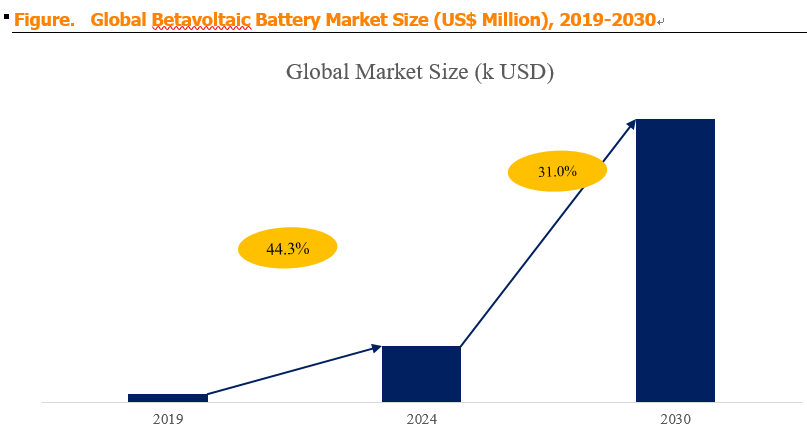
Betavoltaic Battery Market Summary
According to a new market research report published by Market Monitor Global, the global Betavoltaic Battery market was valued at USD 2.07 million in 2023 and is projected to grow to USD 12.89 million by 2030, at a compound annual growth rate (CAGR) of 31% during the forecast period. This exceptionally high growth rate reflects the emerging commercial stage of the technology, increasing investments in R&D, the expanding application pipeline in aerospace, defense, and medical sectors, and the unique value proposition of betavoltaic batteries in applications where battery replacement is impractical or impossible-1.
Market Monitor Global's analysis indicates that the global key manufacturers of Betavoltaic Batteries include City Labs, Inc. (USA), Widetronix (USA), BetaBatt, Inc. (USA), Direct Kinetic Solutions (USA), Qynergy Corp (USA), NUST MISIS (Russia), and NDB Inc. (USA)-1-11. The market is currently characterized by a highly concentrated competitive landscape, with City Labs emerging as the clear market leader-7. City Labs, founded in 2005, holds the nation's only commercial betavoltaic battery license and has established a regulatory-licensed R&D/manufacturing facility in Miami, Florida-2-7. The company's NanoTritium™ technology is the first commercially available betavoltaic battery.
In terms of product type, Nanowatt Battery is the largest segment, holding a 70% share. Nanowatt-range batteries (typically <1 µW) are used in ultra-low-power applications such as sensors, microcontrollers, and backup power for critical systems. Microwatt and higher power batteries account for the remaining share, with increasing development focus on higher-power variants for more demanding applications.
Regarding application, Military is the largest segment, accounting for 57.3% of the market. Military applications include powering anti-tampering circuits, remote sensors, and secure communication devices. Aerospace (including satellite applications) is the second-largest segment. Medical Devices (such as leadless pacemakers, neurostimulators, and cochlear implants) is a high-growth segment, with City Labs receiving NIH awards for developing betavoltaic-powered leadless pacemaker batteries-5. Industrial and Other applications account for the remainder.
Regional dynamics: North America is the largest market, driven by the presence of key players, strong government support for aerospace and defense applications (including NASA and U.S. Air Force programs), and well-established R&D infrastructure-1-11. Europe is a significant market with strong demand from medical device and aerospace applications. Asia-Pacific is the fastest-growing region, driven by increasing investments in medical devices, industrialization, and emerging players such as Betavolt (China), which unveiled a 50-year nuclear battery prototype in early 2024-11.6OWC6ZYJ_~QT_1Z~9.png)
Betavoltaic Battery Market Dynamics
Market Drivers:
-
D1: Long shelf life, high specific energy density, and extreme condition operation – Betavoltaic batteries offer 20+ years of continuous power, orders-of-magnitude higher energy density than chemical batteries, and reliable operation across extreme temperatures (-55°C to 150°C) and harsh environments. These unique attributes make them ideal for applications where battery replacement is difficult, impractical, or life-threatening — such as deep-space missions, underwater sensors, medical implants, and military devices-1-2.
-
D2: Rising investment in aerospace and defense applications – Governments worldwide are escalating investments in space exploration, satellite technology, and defense systems. NASA's Artemis program, the proliferation of LEO satellites, and the modernization of military systems are driving demand for betavoltaic power sources. In 2012, City Labs sold its first generally licensed battery to NASA JPL. In July 2026, City Labs' BOHR satellite — the world's first commercially launched nuclear-powered satellite — was deployed into orbit via a SpaceX Falcon 9 rocket, carrying NanoTritium™ betavoltaic battery technology as a payload-7-9. The U.S. Air Force has also funded City Labs for radioisotope ion engine development-11.
-
D3: Growing medical device applications – The medical sector is driving significant demand for betavoltaic batteries, particularly in:
-
Leadless cardiac pacemakers: Require compact, long-lasting, and highly reliable power sources.
-
Neurostimulators and cerebral stimulators: For treating neurological disorders.
-
Cochlear implants: Requiring durable batteries that minimize replacement procedures.
-
Drug delivery systems and implantable sensors.
City Labs has received multiple NIH awards to develop betavoltaic batteries for leadless pacemaker applications-5. As the prevalence of cardiovascular diseases increases and medical technology continues to miniaturize, demand for betavoltaic power sources in medical devices will grow-1.
-
-
D4: Advancements in material science and semiconductor technology – Ongoing R&D is improving betavoltaic battery efficiency and power output:
-
Novel semiconductor materials: Perovskites, silicon carbide (SiC), gallium arsenide (GaAs), and diamond-based heterojunctions offer higher conversion efficiency and radiation resistance.
-
3D and nanostructured designs: Enhancing the surface area for beta particle capture and improving energy conversion.
-
Tritium-absorbing designs: Integrating tritium directly into semiconductor materials (e.g., tritium-absorbing h-BN/diamond heterojunctions) demonstrates the potential for significantly higher efficiency (up to 13.5%) compared to conventional designs-6.
-
Intrinsic betavoltaic batteries: Incorporating tritium directly into perovskite materials to enable close to 100% absorption of beta particle energy-3-10.
These technological advances are reducing costs, increasing power density, and expanding the addressable market.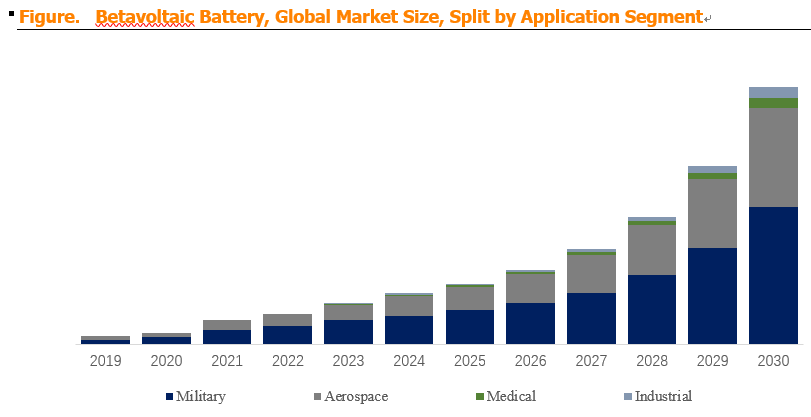
-
Market Restraints:
-
R1: Low conversion efficiency and high cost – Betavoltaic batteries currently suffer from low power conversion efficiency (typically 1-4%), meaning that only a small fraction of the radioactive decay energy is converted into useful electricity-1-3. The remaining energy is lost as heat or unused. Compared to lithium-ion batteries (which are relatively inexpensive and provide higher instantaneous power), betavoltaic batteries are more expensive and are only economically viable in niche applications where long life and maintenance-free operation justify the cost premium-1.
-
R2: Limited awareness and insufficient R&D funding – The technology remains less understood compared to conventional battery solutions. Limited awareness among potential end-users and insufficient R&D funding in certain regions hinder market expansion. This is a particular challenge in emerging markets where conventional battery solutions are readily available and cheaper-1.
-
R3: Regulatory hurdles and supply chain constraints – Betavoltaic batteries contain radioactive isotopes (tritium, nickel-63), requiring regulatory licenses for manufacture, distribution, and use. While City Labs has secured a general license that allows license-free purchases for many applications, regulatory complexity remains a barrier in some jurisdictions. Additionally, tritium supply is limited and concentrated, with most production coming from a few sources (Canada, China, Russia).
Market Opportunities:
-
O1: Integration into space exploration and lunar missions – Betavoltaic batteries are ideal for deep-space missions, lunar exploration, and permanently shadowed regions of the Moon (where solar power is unavailable). City Labs' NanoTritium™ batteries have been deployed in space applications, including partnerships with NASA and Northrop Grumman-7-9. As space exploration expands, demand for reliable, long-lived power sources will grow.
-
O2: Medical implantable devices – The trend toward miniaturization and long-term implantable medical devices (leadless pacemakers, neurostimulators, glucose monitors, drug delivery systems) creates significant opportunities for betavoltaic batteries. These applications prioritize safety, longevity, and compactness — attributes that betavoltaic batteries uniquely offer-1.
-
O3: Development of higher-power and higher-efficiency designs – Ongoing research into novel semiconductor materials, 3D structures, and tritium-absorbing designs is gradually improving power density and efficiency. As these technologies mature, the addressable market will expand beyond ultra-low-power applications to include more demanding use cases (wireless sensors, microcontrollers, portable devices).
-
O4: Emerging applications in IoT and remote sensing – The proliferation of IoT devices in remote or hazardous environments (e.g., industrial monitoring, environmental sensing, undersea monitoring) is driving demand for long-lasting, maintenance-free power sources. Betavoltaic batteries can provide decades of power for such sensors without replacement-11.
-
O5: Geographic expansion in Asia-Pacific – The Asia-Pacific region is emerging as a significant growth market, driven by investments in medical devices, industrialization, and renewable energy. Chinese startup Betavolt's announcement of a 50-year nuclear battery in early 2024 signals growing regional interest and development-11.
1MV~8M2{R6SGVQ.png)
Industry Trends:
-
Explosive market growth: The market is projected to grow from $2.07 million in 2023 to $12.89 million by 2030 (31% CAGR), reflecting increasing commercial adoption, R&D investment, and expanding applications.
-
Dominance of nanowatt batteries: Nanowatt batteries (~70% share) dominate the market, reflecting the current technical limitations and primary applications (sensors, microelectronics).
-
Military as largest application: Military applications (~57%) lead demand, driven by secure communication, anti-tampering, and remote sensing needs.
-
Focus on tritium as the preferred isotope: Tritium is the most commonly used isotope due to its low energy, low toxicity, and favorable decay characteristics (12.32-year half-life, average beta energy of 5.7 keV)-3.
-
Technological innovation: R&D efforts are focused on novel semiconductor materials, 3D structures, intrinsic betavoltaic designs, and tritium-absorbing heterojunctions to improve efficiency and power density-6.
-
Single-player dominance: The market remains extremely concentrated, with City Labs holding a dominant position due to its exclusive commercial license, technology leadership, and regulatory expertise-7.
Industry Structure and Competitive Dynamics
The global Betavoltaic Battery market is characterized by an extremely concentrated competitive landscape:
-
Market leader (City Labs, Inc.): City Labs is the clear leader, holding the nation's only commercial betavoltaic battery license-2. Its key advantages include:
-
Pioneering technology: Developed the first commercially available betavoltaic battery (NanoTritium™).
-
Regulatory expertise: Decades of regulatory experience and exclusive licensing.
-
Established customer base: Partnerships with NASA JPL, Northrop Grumman, and other government and commercial entities.
-
Proven applications: Batteries deployed in space, military, and medical applications.
-
Strong R&D: Continuous innovation, including recent NIH awards for pacemaker applications-5.
-
-
Other significant players (Widetronix, BetaBatt, Direct Kinetic Solutions, Qynergy Corp, NUST MISIS, NDB Inc.): These companies are developing competitive betavoltaic technologies. NDB Inc. (USA) and NUST MISIS (Russia) have demonstrated high-efficiency prototypes. Chinese player Betavolt entered the market in early 2024, announcing a 50-year nuclear battery prototype.
LS6}6]_J}]B5MQGDMG.png)
Key success factors in this market:
-
Regulatory compliance: Navigating licensing and safety requirements across jurisdictions.
-
Technology and innovation: Developing higher efficiency, higher power, and lower-cost designs.
-
Customer relationships: Building partnerships with defense, aerospace, and medical device manufacturers.
-
Supply chain: Securing tritium supply and managing isotope logistics.
-
Cost competitiveness: Reducing manufacturing costs to expand addressable market.


