 +1-3236076188
 sales@marketmonitorglobal.com
 Log In
  Log In
 Home>News>Global Travel Management Company (TMC) Market to Reach $37.09 Billion by 2030, Growing at 5.0% CAGR
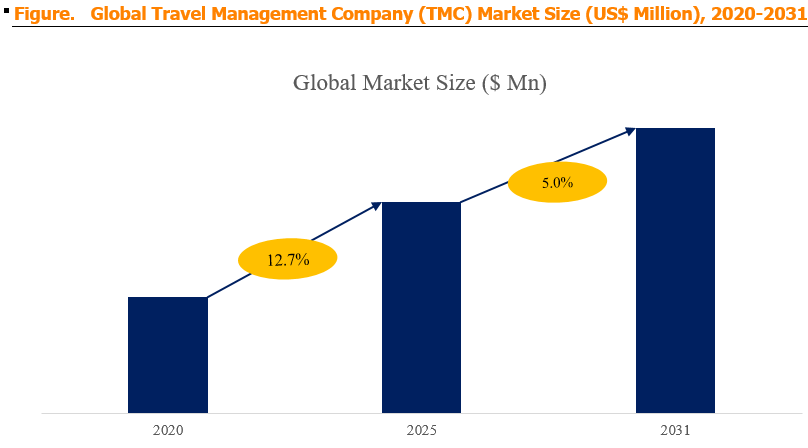
Global Travel Management Company (TMC) Market to Reach $37.09 Billion by 2030, Growing at 5.0% CAGR
Monday,06 Jul,2026
Travel Management Company (TMC): Definition and Principles
A Travel Management Company (TMC) — also referred to as a Corporate Travel Management Company or Commercial Travel Office (CTO) — is a specialized travel agency that helps businesses and organizations manage their corporate travel. Unlike consumer-focused travel agencies (which serve individual leisure travelers), TMCs provide comprehensive, integrated travel management services tailored to the needs of corporate clients, including:
-
Travel booking and reservations: Flights, hotels, car rentals, rail, and other ground transportation.
-
Travel policy compliance: Enforcing company travel policies (e.g., preferred suppliers, class of service, advance purchase requirements).
-
Traveler tracking and risk management: Monitoring traveler locations during emergencies (natural disasters, political unrest, health crises) and providing real-time safety alerts and support.
-
Expense management: Integration with expense reporting systems to automate reconciliation and reimbursement.
-
Duty of care: Ensuring the safety and well-being of traveling employees.
-
Reporting and analytics: Providing data on travel spend, supplier performance, policy compliance, and cost-saving opportunities.
-
Negotiation and supplier management: Leveraging aggregated spend to negotiate favorable corporate rates with airlines, hotels, and other travel suppliers.
TMCs operate as intermediaries between corporate clients and travel suppliers (airlines, hotel chains, car rental companies, rail operators, etc.), using their scale, technology platforms, and industry relationships to deliver cost savings, efficiency, and risk mitigation. Modern TMCs have evolved significantly from traditional travel agencies, leveraging technology, data analytics, and digital platforms (mobile apps, online booking tools, AI-driven personalization) to enhance the traveler experience and optimize corporate travel programs.~QL5$E3HT7$S6.webp)
Key service delivery models:
-
Full-service TMC: End-to-end travel management, including booking, policy management, traveler support, risk management, expense integration, and strategic consulting.
-
Online booking tool (OBT) providers: Self-service booking platforms (e.g., SAP Concur, Amadeus Cytric, Egencia, Navan) where travelers book their own travel within company policy, with TMC support for complex bookings or exceptions.
-
Hybrid: Combination of self-service online booking and access to TMC agents for complex or high-value bookings.
-
Mobile-first: Travelers use mobile apps for booking, itinerary management, expense tracking, and real-time alerts (e.g., TravelPerk, Navan).
-
Managed travel programs: TMC provides strategic consulting, spend analysis, supplier negotiation, and policy design, in addition to booking and support.
Travel Management Company (TMC) Market Summary
According to a new market research report published by Market Monitor Global, the global Travel Management Company (TMC) market is projected to reach USD 37.09 billion by 2030, at a compound annual growth rate (CAGR) of 5.0% during the forecast period. This growth is driven by the recovery of business travel following the COVID-19 pandemic, increasing demand for integrated travel and expense management solutions, the rise of hybrid work models (which require more flexible travel policies), and the growing adoption of technology-driven, traveler-centric TMC platforms.
Market Monitor Global's analysis indicates that the global key manufacturers (market leaders) of Travel Management Companies include AMEX GBT (Egencia) (USA), BCD Travel (Netherlands), SAP Concur (USA/Germany), JTB Business Travel (Japan), CWT (USA), FCM Travel (Australia/UK), Corporate Travel Management (CTM) (Australia), Direct Travel (USA), Navan (USA), and TravelPerk (Spain). In 2024, the global top five players collectively accounted for approximately 27.0% of total revenue, indicating a fragmented market with numerous regional and niche players alongside a few large global consolidators. The top players are characterized by strong global networks, advanced technology platforms, extensive supplier relationships, and deep corporate client portfolios.
In terms of product type, Service is currently the largest segment, holding a 55.4% share of the market. This includes agent-assisted booking, traveler support, risk management, expense management, reporting, and consulting services. The Software/Technology segment (online booking tools, mobile apps, expense management platforms, AI-driven analytics) accounts for the remaining share. While software is growing rapidly (as clients demand more self-service, automation, and data integration), services remain essential for complex itineraries, high-value bookings, traveler support, and strategic consulting.
Regarding application (by client size and type), Large Enterprises is the largest segment, accounting for 38.5% of the market. Large enterprises (>1,000 employees) typically have complex travel programs requiring significant TMC support, including policy management, supplier negotiations, and global traveler tracking. Mid-Market Enterprises (250-1,000 employees) account for the next-largest share, followed by Small Enterprises (<250 employees). Other segments (including government, non-profit, and educational institutions) represent the remainder.
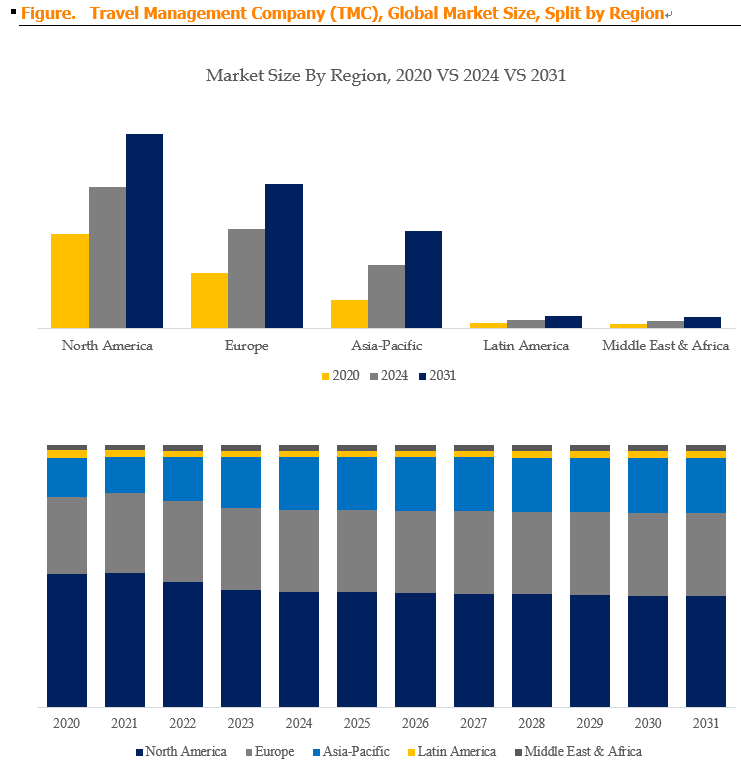
Regional dynamics: North America is the largest market, driven by a strong corporate travel culture, a large number of multinational enterprises, advanced technology adoption, and the presence of major TMC players (AMEX GBT, CWT, Direct Travel, Navan). Europe is the second-largest market, with a strong corporate travel ecosystem, major TMC players (BCD Travel, CWT, FCM Travel, TravelPerk, SAP Concur), and a high concentration of multinational companies. Asia-Pacific is the fastest-growing region, driven by rapid corporate expansion in China, India, Japan, and Southeast Asia, increasing business travel budgets, and the growing adoption of corporate travel management solutions. Latin America and Middle East & Africa are smaller but growing markets, driven by economic development and increasing business travel.
Travel Management Company (TMC) Market Dynamics
Market Drivers:
-
D1: Recovery and growth of business travel – Business travel spending is recovering strongly post-COVID-19. According to the Global Business Travel Association (GBTA), global business travel spending is projected to reach pre-pandemic levels by 2025-2026 and continue to grow thereafter. Factors driving this growth include:
-
In-person meetings: Return to in-person conferences, trade shows, sales meetings, and client visits.
-
Collaboration: Increased need for face-to-face collaboration, team-building, and relationship-building in a hybrid work environment.
-
International expansion: Growth of multinational companies expanding into new markets, driving international business travel.
-
M&A activity: Mergers and acquisitions drive travel for integration, due diligence, and organizational alignment.
-
-
D2: Increasing demand for integrated travel and expense management – Corporates are seeking to streamline travel and expense management processes to reduce costs, improve compliance, and enhance traveler experience. TMCs with integrated technology platforms (booking + expense + reporting + analytics) offer significant value by:
-
Reducing administrative burden: Automating expense reporting, reconciliation, and reimbursement.
-
Improving policy compliance: Real-time policy enforcement at point of booking.
-
Enhancing visibility: Providing real-time visibility into travel spend, supplier performance, and traveler activity.
-
Enabling data-driven decisions: Using analytics to optimize travel programs, negotiate better rates, and identify cost-saving opportunities.
-
-
D3: Rise of hybrid work models and flexible travel policies – The shift to hybrid work has changed corporate travel patterns: there is an increase in "bleisure" travel (business + leisure), regional/local travel, and "pop-up" meetings. TMCs must adapt by offering flexible booking policies, "workation" capabilities, and enhanced traveler support for longer, more complex trips. Additionally, sustainability concerns (e.g., carbon footprint reduction) are increasingly influencing travel policies, creating demand for carbon offsetting, sustainable travel options, and reporting on environmental impact.
-
D4: Growing adoption of AI and automation in travel management – TMCs are leveraging AI (artificial intelligence) and machine learning to:
-
Personalize traveler experiences: Recommend flights, hotels, and travel options based on traveler preferences and past behavior.
-
Automate routine tasks: Chatbots for traveler support, automated booking confirmations, and automated expense categorization.
-
Optimize travel programs: Predictive analytics for demand forecasting, spend optimization, and supplier negotiation.
-
Enhance duty of care: Real-time risk assessment, traveler tracking, and automated alerts during disruptions.
AI-driven TMC solutions improve efficiency, reduce costs, and enhance traveler satisfaction.
-
-
D5: Increasing focus on duty of care and traveler safety – Corporate clients prioritize traveler safety and well-being. TMCs offer:
-
Traveler tracking: Real-time tracking of traveler locations and itineraries.
-
Risk monitoring: Monitoring global events (natural disasters, political unrest, health crises) and providing real-time alerts and support to travelers.
-
24/7 traveler support: Access to agents via phone, chat, or app for assistance with emergencies, itinerary changes, or medical needs.
-
Compliance and documentation: Ensuring travelers have necessary visas, vaccinations, and travel authorizations.
This duty of care focus has become a key differentiator for TMCs, with clients willing to pay a premium for comprehensive risk management.
-
BNOB$UU.png)
Market Restraints:
-
R1: Economic uncertainty and inflationary pressures – Business travel budgets are sensitive to economic conditions. In periods of economic slowdown, companies reduce travel budgets, delay non-essential trips, and tighten travel policies. Inflation (higher airfares, hotel rates, food and beverage costs) increases travel costs, potentially reducing travel volumes or shifting to lower-cost options. TMC revenue is closely correlated with business travel spend; economic downturns directly impact TMC revenues.
-
R2: Competition from direct booking and consumer travel platforms – Corporate travelers and smaller companies may book directly with suppliers (airlines, hotels) or use consumer travel platforms (Expedia, Booking.com, Agoda) for perceived cost savings or convenience. However, these options lack the policy enforcement, reporting, risk management, and negotiated rates that TMCs provide. TMCs must clearly communicate their value proposition (cost savings, compliance, duty of care) to retain corporate clients.
-
R3: Complexity of global travel management – Managing travel across multiple countries involves:
-
Different cultures, languages, and business practices.
-
Diverse supplier landscapes (airlines, hotel chains, car rental companies, rail operators) with varying service quality and pricing.
-
Regulatory requirements: Visa, customs, tax, and employment laws across jurisdictions.
-
Data privacy and security: GDPR in Europe, CCPA in California, and other regional data protection laws.
This complexity requires TMCs to have deep local knowledge, strong global networks, and robust technology platforms. Smaller TMCs may struggle to compete globally.G3XRQRHS78BXS]M]9.png)
-
Market Opportunities:
-
O1: Expansion into emerging markets (Asia-Pacific, Latin America, Middle East) – As corporate travel grows in emerging markets, TMCs have an opportunity to establish local presence, build local partnerships, and capture market share. Key growth markets include:
-
China: Rapid corporate expansion, increasing business travel budgets, and growing demand for corporate travel management.
-
India: Rapid economic growth, expanding corporate sector, and increasing business travel.
-
Southeast Asia: Growing corporate hubs in Singapore, Malaysia, Thailand, and Vietnam.
-
Latin America: Brazil, Mexico, and Colombia are key markets with growing business travel.
-
Middle East: Dubai, Abu Dhabi, Riyadh, and Doha are hubs for international business.
-
-
O2: Integration with ESG (Environmental, Social, Governance) and sustainability – Corporate clients are increasingly focused on sustainability: reducing carbon footprint, investing in carbon offsets, and promoting sustainable travel (e.g., rail over short-haul flights, eco-friendly hotels). TMCs that offer comprehensive sustainability solutions — including carbon footprint tracking, carbon offsetting, sustainable travel options, and reporting — can differentiate themselves and attract ESG-conscious clients.
-
O3: Development of AI-driven predictive analytics for travel program optimization – TMCs can use AI and machine learning to:
-
Forecast travel demand: Predict travel volumes, spend, and patterns to optimize supplier negotiations and capacity planning.
-
Optimize travel programs: Identify opportunities to consolidate spend, negotiate better rates, and improve policy compliance.
-
Personalize traveler experiences: Recommend personalized travel options, itineraries, and alerts.
-
Enhance duty of care: Predict and proactively manage travel risks, disruptions, and emergency response.
Predictive analytics adds significant value to corporate clients and strengthens TMC-client relationships.
-
-
O4: Consolidation and M&A in the TMC industry – The TMC industry is fragmented, with many regional and small players. Consolidation (mergers and acquisitions) can enable TMCs to:
-
Scale: Achieve economies of scale, reduce costs, and improve profitability.
-
Expand geographic coverage: Enter new markets, acquire local expertise, and grow regional footprint.
-
Enhance technology capabilities: Acquire technology platforms, AI capabilities, and digital solutions.
-
Diversify client base: Reduce reliance on specific industries or regions.
M&A activity is expected to increase as TMCs seek to compete with global leaders (AMEX GBT, BCD Travel, SAP Concur) and respond to client demands for global, integrated solutions.
-
-
O5: Expansion into adjacent services – TMCs can expand beyond traditional travel management into adjacent services:
-
Event management: Meeting planning, conference management, and event logistics.
-
Meetings and incentives: Incentive travel, team-building events, and recognition programs.
-
Spend management: End-to-end spend management (travel + procurement + expenses).
-
Consulting: Strategic consulting on travel program design, supplier negotiation, and sustainability.
Adjacent services increase revenue per client, deepen relationships, and enhance TMC value proposition.
-
Industry Trends:
-
Technology and automation: AI-powered chatbots, automated booking, expense management, and predictive analytics.
-
Mobile-first traveler experience: Mobile apps for booking, itinerary management, expense reporting, and real-time alerts.
-
Sustainability and ESG: Carbon footprint tracking, sustainable travel options, and carbon offsetting.
-
Personalization: Tailored travel recommendations, dynamic pricing, and personalized support based on traveler preferences.
-
Integration with expense management: Seamless integration between booking, expense reporting, and reimbursement.
-
Duty of care and traveler safety: Real-time traveler tracking, risk monitoring, and 24/7 emergency support.
-
Consolidation: M&A activity to achieve scale, geographic expansion, and technology enhancements.
Industry Structure and Competitive Dynamics
The global Travel Management Company (TMC) market is characterized by:
-
Global leaders (AMEX GBT, BCD Travel, CWT, FCM Travel, CTM): These companies have global presence, extensive supplier networks, advanced technology platforms, and deep corporate client relationships. They compete on global service capability, technology, and scale.
-
Technology-focused players (SAP Concur, Navan, TravelPerk): These companies have advanced online booking, expense management, and AI-driven analytics platforms. They compete on technology innovation, user experience, and ease of integration with other corporate systems.
-
Regional and niche players: Many regional TMCs with strong local presence, local supplier relationships, and regional client bases. They compete on local expertise, personalized service, and cost competitiveness.
-
Diversified players (JTB Business Travel, Direct Travel): Companies with a mix of corporate travel, leisure travel, meetings/events, and other services.
Key success factors in this market:
-
Technology platform: Robust online booking, expense management, analytics, and AI capabilities.
-
Global network: Strong presence in key markets and ability to serve multinational clients.
-
Supplier relationships: Negotiated rates, preferred supplier agreements, and access to inventory.
-
Traveler experience: User-friendly interfaces, mobile apps, personalized service, and traveler support.
-
Duty of care and risk management: Real-time traveler tracking, risk monitoring, and 24/7 support.
-
Cost management: Competitive pricing, efficient operations, and cost-effective service delivery.
-
Data and analytics: Advanced reporting, spend analysis, and actionable insights for corporate clients.


